
The Hidden Disconnect#
The engineering manager stared at the dashboard showing three days of stale customer analytics data. Marketing couldn’t run campaigns. Product couldn’t measure feature adoption. The CEO kept asking why their “data-driven” company felt so blind. Meanwhile, the team labeled “data engineers” spent their days wrestling with Kafka configurations, debugging Spark jobs, and explaining why the warehouse costs kept climbing. Something fundamental was broken in how they understood their own role.
This disconnect between expectation and reality reveals a deeper problem. Data engineering has become a catch-all term that obscures more than it clarifies. Teams struggle to define scope, set boundaries, and measure success because the role itself remains poorly understood. The result is misaligned expectations, unclear career paths, and systems that serve technology instead of business outcomes.
The Reliability Dividend#
When data engineering is done right, it becomes the invisible infrastructure that powers confident decision-making. Fresh data flows reliably from source systems to analytics tools. Machine learning models train on trusted datasets. Business users access insights without waiting for engineering tickets. The organization moves faster because data moves faster.
When it’s done wrong, the costs compound quickly. Engineering teams spend more time maintaining pipelines than building new capabilities. Business stakeholders lose trust in data quality. Technical debt accumulates in complex, brittle systems that resist change. The promise of data-driven decision-making becomes a source of frustration rather than competitive advantage. Understanding what data engineering truly encompasses—and what it doesn’t—determines which path your organization takes.
The Utility Definition#
Data engineering is the practice of designing, building, and maintaining systems that collect, store, process, and serve data reliably at scale. It focuses on the infrastructure and workflows that enable other teams to extract value from data. The discipline sits at the intersection of software engineering, distributed systems, and business requirements.
The core responsibilities center on data movement and transformation. Data engineers build pipelines that extract data from source systems, transform it into useful formats, and load it into storage systems where analysts, scientists, and applications can access it. They design schemas, manage data quality, monitor system health, and ensure data governance requirements are met.
Not this: Data engineering is not data science, analytics, or machine learning. While data engineers enable these disciplines, they typically don’t build predictive models, create dashboards, or conduct statistical analysis. It’s also not traditional database administration, though it shares some operational concerns.
The Water System Model#
Think of data engineering as building and maintaining a city’s water system. Raw water comes from various sources—rivers, wells, reservoirs. It flows through treatment plants where it’s cleaned and processed. Distribution networks carry it to homes, businesses, and industrial facilities. Quality monitoring ensures safety. Maintenance teams fix leaks and upgrade infrastructure.
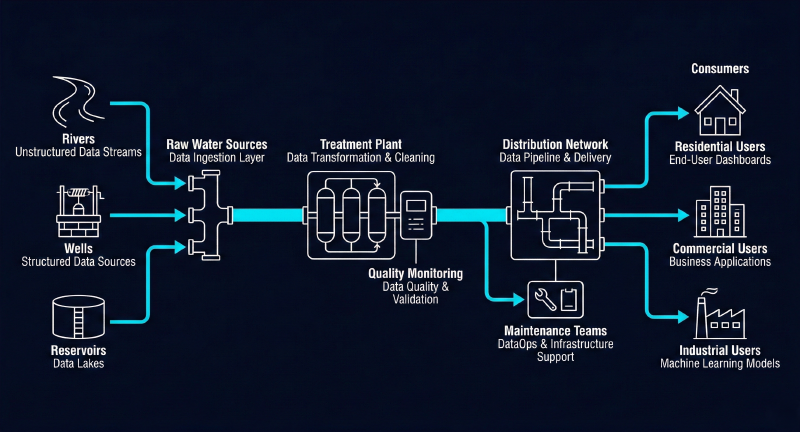
Like municipal water systems, data systems must be reliable, scalable, and cost-effective. They serve diverse consumers with different needs. They require ongoing maintenance and monitoring. When they fail, the impact cascades through everything that depends on them. The best systems become invisible to their users—water flows when you turn the tap, data appears when you run the query.
The Responsibility Matrix#
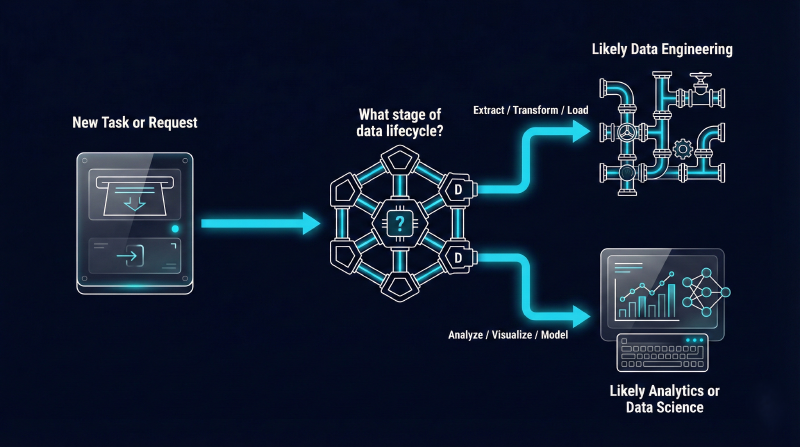
Determining whether a task belongs to data engineering requires evaluating three dimensions: data lifecycle stage, technical complexity, and business impact. Start by identifying where the work falls in the data journey from source to consumption.
Step 1: Identify the Data Lifecycle Stage
Step 2: Evaluate Technical Complexity and Business Impact
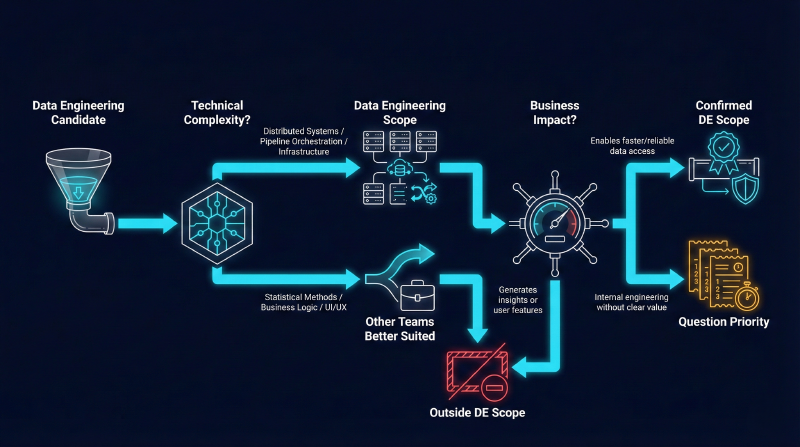
If the task involves extracting data from source systems, transforming it for downstream use, or ensuring reliable delivery to consumers, it likely belongs to data engineering. If it involves analyzing data to generate insights, building predictive models, or creating visualizations, it probably belongs to analytics or data science teams.
Technical complexity provides the second filter. Data engineering work typically involves distributed systems, data modeling, pipeline orchestration, and infrastructure concerns. It requires understanding of storage formats, processing engines, and scalability patterns. Work that focuses on statistical methods, business logic, or user interfaces usually falls outside the data engineering scope.
Business impact offers the final consideration. Data engineering work should directly enable faster, more reliable, or more cost-effective data access for downstream consumers. If the work primarily serves internal engineering concerns without clear business value, question whether it’s the right priority. If it directly generates business insights or drives user-facing features, consider whether other teams might be better positioned to own it.
Real-world patterns and what they teach#
Hypothetical example: A growing e-commerce company initially had their backend engineers handle data extraction by writing custom scripts that dumped database tables to CSV files nightly. As the business scaled, these scripts began failing regularly, consuming increasing amounts of engineering time, and creating data quality issues that affected reporting accuracy. The company hired their first data engineer, who replaced the ad-hoc scripts with a proper ETL pipeline using Apache Airflow and implemented data quality checks that caught issues before they reached analysts.
This pattern repeats across organizations of all sizes. Data engineering emerges as a distinct discipline when the volume, velocity, or variety of data exceeds what general-purpose engineering teams can handle effectively. The transition point varies, but common triggers include multiple data sources, real-time requirements, compliance needs, or dedicated analytics teams that depend on reliable data access.
The lesson is that data engineering becomes valuable when data systems require specialized expertise to operate reliably. Organizations that recognize this transition early can avoid the technical debt and reliability issues that accumulate when data infrastructure is treated as a side project rather than a core capability.
The Modern Blueprint#
Begin by mapping your current data landscape. Document all data sources, transformation logic, storage systems, and downstream consumers. Identify the most critical data flows that support business operations or decision-making. This inventory reveals where data engineering can add the most value.
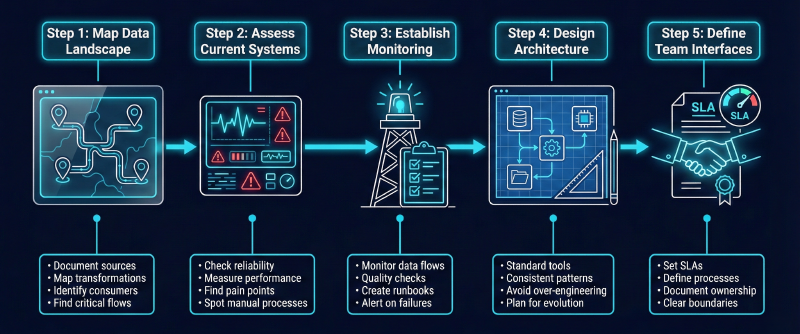
Next, assess the reliability and performance of existing data systems. Look for pipelines that fail frequently, data that arrives late or with quality issues, and manual processes that consume significant engineering time. These pain points represent opportunities for data engineering improvements.
Establish basic monitoring and alerting for critical data flows. Implement data quality checks at key transformation points. Create runbooks for common failure scenarios. These operational foundations prevent small issues from becoming major incidents.
Design a simple, consistent architecture for new data pipelines. Choose standard tools and patterns that your team can support effectively. Avoid over-engineering early systems, but ensure they can evolve as requirements change.
Finally, define clear interfaces between data engineering and adjacent teams. Establish service level agreements for data freshness and quality. Create processes for requesting new data sources or transformations. Document who owns what in the data lifecycle. Clear boundaries prevent confusion and ensure accountability.
Metrics of Vitality#
Success in data engineering is measured through four key dimensions: freshness, reliability, quality, and cost.
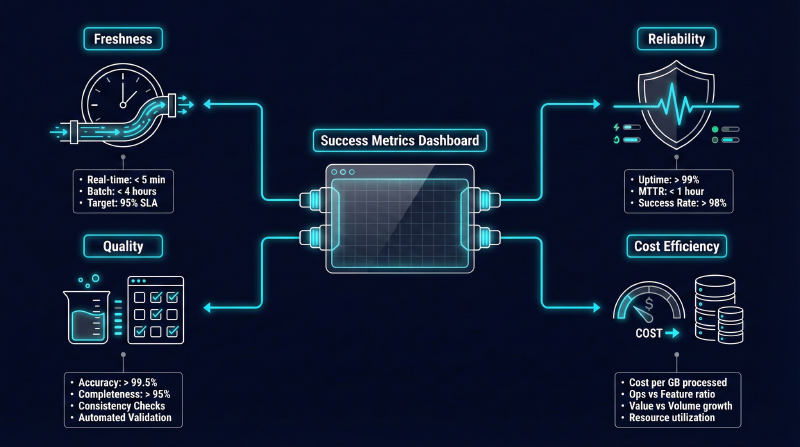
Freshness tracks how quickly data moves from source systems to downstream consumers. Typical targets range from minutes for real-time use cases to hours for batch analytics, depending on business requirements.
Reliability measures system uptime and pipeline success rates. Most teams target availability above ninety-nine percent for critical data flows, with mean time to recovery under one hour for major incidents. Quality metrics track data accuracy, completeness, and consistency through automated validation rules and reconciliation checks.
Cost efficiency balances infrastructure spending against business value delivered. Monitor compute and storage costs per unit of data processed. Track the ratio of operational overhead to new feature development. Watch for cost growth that outpaces data volume or business value.
Leading indicators include pipeline execution times, error rates, and resource utilization trends. These metrics help identify problems before they impact downstream consumers.
For resilience, implement circuit breakers that prevent cascading failures when upstream systems become unavailable. Maintain the ability to replay data from persistent storage when pipelines need to be rebuilt or corrected. Design systems with graceful degradation so partial failures don’t cause complete outages.
The Economics of Infrastructure#
Data engineering costs fall into three primary categories: compute, storage, and operational overhead. Compute costs scale with data volume and processing complexity. Storage costs grow with data retention requirements and access patterns. Operational overhead includes monitoring, maintenance, and incident response.
The most effective cost levers are data lifecycle management, processing optimization, and infrastructure right-sizing. Implement automated data retention policies that archive or delete data based on business value and compliance requirements. Optimize processing jobs to use resources efficiently and avoid unnecessary data movement. Size infrastructure to match actual usage patterns rather than peak theoretical demand.
Two major risks threaten data engineering initiatives. Technical debt accumulates when short-term solutions become permanent fixtures. This happens when teams prioritize delivery speed over maintainability, leading to brittle systems that resist change and consume increasing operational effort. Mitigate this risk by allocating time for refactoring and establishing technical standards that prevent the worst anti-patterns.
Scope creep represents the second major risk. Data engineering teams often become catch-all resources for any data-related work, diluting focus and reducing effectiveness. Combat this by maintaining clear role boundaries and service definitions. Establish processes for evaluating new requests against strategic priorities and team capacity.
Engineering for Durability#
If stakeholders frequently request “just one more field” or “slightly different aggregation,” design your transformation layer for extensibility from the start. Schema evolution and parameterized transformations cost less than rebuilding pipelines repeatedly. Monitor how often you modify existing pipelines versus creating new ones.
If you find yourself explaining the same data concepts repeatedly, invest in self-service tooling and documentation. The best data engineering work enables others to be productive without constant support. Track the ratio of support requests to active users as a measure of system usability.
Common Infrastructure Failures#
The most common data engineering problems follow predictable patterns. Understanding these patterns helps you recognize and address issues before they become critical system failures.
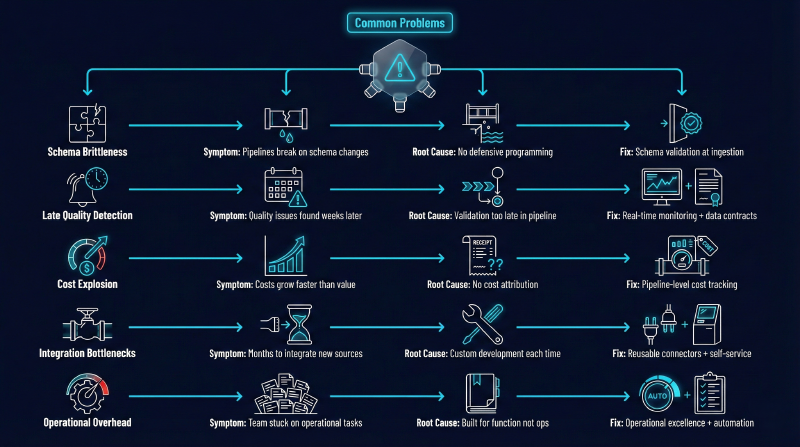
Schema Brittleness: Pipelines break whenever source systems change their schema or data format. This stems from lack of defensive programming and schema validation in extraction logic. Implement schema detection and validation at ingestion points. Design pipelines to handle missing fields gracefully and alert on unexpected schema changes rather than failing silently.
Late Quality Detection: Data quality issues are discovered days or weeks after they occur, affecting multiple downstream systems. Quality checks happen too late in the pipeline, after data has already been distributed. Move validation closer to data sources and implement real-time monitoring of key quality metrics. Establish data contracts with upstream systems that define expected formats and quality standards.
Cost Explosion: Infrastructure costs grow faster than data volume or business value, with no clear understanding of what drives expenses. This results from lack of cost attribution and monitoring at the pipeline level. Implement cost tracking that maps expenses to specific data products or business use cases. Establish cost budgets for different types of workloads and alert when spending exceeds expectations.
Integration Bottlenecks: New data sources take weeks or months to integrate, creating bottlenecks for business initiatives. Each integration requires custom development work due to lack of standardized patterns. Build reusable connectors and transformation templates for common source types. Create self-service tooling that allows business users to configure simple integrations without engineering involvement.
Operational Overhead: Team spends most of their time on operational tasks like monitoring, debugging, and manual fixes rather than building new capabilities. Systems were built for functionality rather than operability, creating high maintenance overhead. Prioritize operational excellence in system design. Implement comprehensive monitoring, automated recovery procedures, and self-healing capabilities. Measure and optimize mean time to detection and recovery for common failure modes.
Conclusion: The Utility Mindset#
Data engineering succeeds when it becomes the reliable infrastructure that enables data-driven decision-making throughout an organization. Like a well-designed water system, the best data engineering work becomes invisible to its users—data flows when needed, quality is assured, and costs remain predictable.
The mental model of infrastructure provider rather than data consumer helps clarify the role’s boundaries and value proposition. Data engineers build the pipes, not the insights. They ensure reliability, not analysis. They enable speed, not strategy. This focus creates clear accountability and measurable outcomes.
Today, you can start by mapping one critical data flow in your organization. Document its sources, transformations, and consumers. Identify its failure modes and recovery procedures. Measure its freshness, reliability, and cost. This exercise will reveal whether your data engineering practices match your business needs—and where to focus improvement efforts next.
The foundation we’ve established here leads naturally to understanding how data engineering has evolved over time and where it’s heading. The next article explores the historical forces that shaped modern data engineering practices and the architectural patterns that emerged from real-world constraints.
What data engineering challenges are you facing? Connect with me on LinkedIn to share your thoughts.