
The Legacy Burden#
The architect stared at the migration plan spread across three monitors. Legacy ETL jobs that had run faithfully for fifteen years now took six hours to complete what should finish in thirty minutes. The data warehouse that once seemed infinitely scalable groaned under modern workloads. Meanwhile, the business demanded real-time insights, machine learning capabilities, and cloud-native flexibility that the current architecture simply couldn’t deliver.
This moment of reckoning plays out in organizations worldwide as they confront the accumulated weight of architectural decisions made decades ago. The systems that powered the first wave of business intelligence now struggle with modern data volumes, velocity, and variety. Understanding how we arrived at this point and why each generation of data architecture emerged provides the context needed to navigate today’s choices between cloud warehouses, data lakes, and lakehouse platforms.
The history of data engineering isn’t just academic curiosity. It’s a map of the trade-offs, constraints, and breakthrough innovations that created today’s landscape. Each architectural shift responded to specific limitations of its predecessor, creating new capabilities while introducing fresh challenges that would drive the next evolution.
The Innovation Cycle#
Organizations that understand data engineering’s evolutionary path make better architectural decisions today. They recognize which patterns have proven durable across technology shifts and which represent temporary solutions to specific constraints. This historical perspective prevents repeating expensive mistakes and helps identify when emerging technologies address real limitations versus creating new complexity.
When teams grasp the forces that drove each architectural transition, they can evaluate modern platforms more effectively. They understand why certain design patterns emerged, what problems they solved, and what new challenges they created. This knowledge translates directly into better vendor selection, more realistic migration planning, and architectures that evolve gracefully rather than requiring periodic wholesale replacement.
The alternative is architectural decision-making based on marketing claims and surface-level feature comparisons. Teams that lack historical context often chase the latest technology without understanding its trade-offs, leading to premature migrations, vendor lock-in, and systems that solve yesterday’s problems while creating tomorrow’s technical debt.
The Four Eras of Data#
Data engineering history spans roughly four decades, from the emergence of relational databases in the early 1980s through today’s cloud-native lakehouse architectures. This evolution reflects changing business requirements, technological capabilities, and economic constraints that shaped how organizations collect, store, and process data.
The historical scope covers major architectural paradigms rather than specific vendor implementations. We examine the transition from mainframe batch processing to client-server data warehouses, the rise of distributed computing with Hadoop, the cloud transformation that enabled elastic scaling, and the current convergence toward unified analytics platforms.
Each era brought distinct patterns for data movement, storage, and processing. The ETL-centric warehouse era emphasized structured data and batch processing. The big data revolution introduced schema-on-read and distributed computing. Cloud platforms enabled separation of compute and storage. Modern lakehouses attempt to combine the best aspects of previous approaches while addressing their limitations.
Not this: This isn’t a comprehensive technology timeline or vendor comparison guide. We focus on architectural decisions and their business drivers rather than implementation details or product features. The goal is understanding why certain patterns emerged and what problems they solved, not cataloging every tool or platform.
The Urban Planning Model#
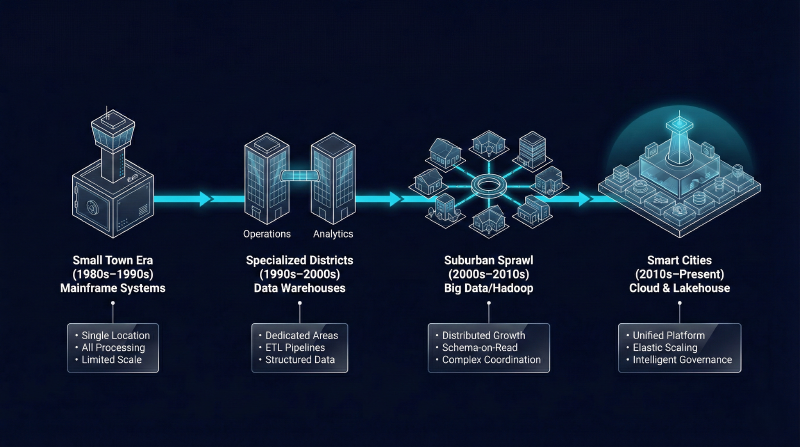
Think of data engineering evolution as urban development responding to population growth and changing needs. Early settlements built simple structures that worked for small communities. As populations grew, cities developed specialized districts - residential, commercial, industrial - each optimized for specific functions but requiring coordination and infrastructure to connect them.
The first data systems resembled small towns where everything happened in one place. Mainframe computers processed transactions and generated reports using the same hardware and storage. As data volumes grew, organizations built specialized districts: operational systems for transactions, data warehouses for analytics, and ETL processes to move data between them.
The big data era was like suburban sprawl—distributed systems spread processing across many machines, but coordination became complex and expensive. Cloud computing introduced urban planning principles: shared infrastructure, elastic scaling, and specialized services that could be combined as needed. Modern lakehouses represent smart city design: unified platforms that support diverse workloads while maintaining efficiency and governance.
This urban development analogy helps explain why each architectural shift occurred. Cities don’t rebuild from scratch every generation; they evolve by addressing specific constraints while preserving valuable existing infrastructure. Similarly, successful data architectures build on proven patterns while solving new problems, rather than discarding everything that came before.
The Evolution Matrix#
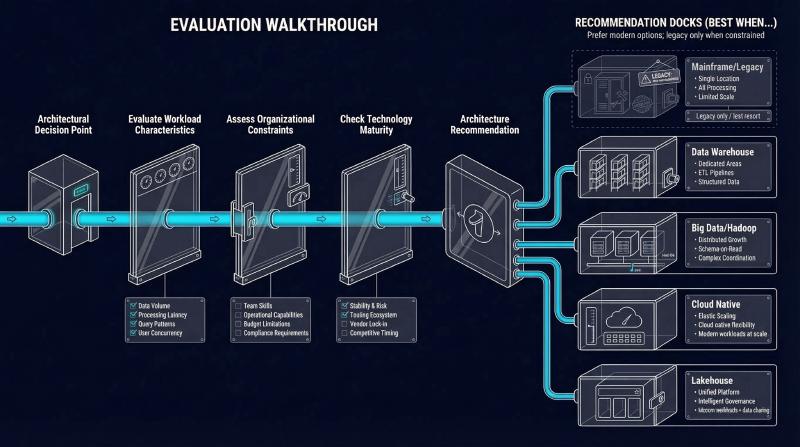
Evaluating data architecture choices requires understanding three key dimensions: workload characteristics, organizational constraints, and technology maturity. Historical patterns show that successful architectures align these factors rather than optimizing any single dimension.
Workload characteristics include data volume, processing latency requirements, query patterns, and user concurrency. Early data warehouses optimized for structured data and complex analytical queries. Hadoop systems handled massive volumes of unstructured data but with higher latency. Cloud platforms enabled elastic scaling for variable workloads. Each architecture excelled in specific scenarios while struggling with others.
Organizational constraints encompass team skills, operational capabilities, budget limitations, and compliance requirements. The most elegant technical solution fails if the organization cannot implement, operate, or afford it. Historical examples show that sustainable architectures match organizational capabilities rather than requiring dramatic skill or process changes.
Technology maturity determines what’s possible within acceptable risk levels. Early adopters of new paradigms often face stability issues, limited tooling, and vendor lock-in risks. Late adopters miss competitive advantages but benefit from proven patterns and mature ecosystems. The optimal timing depends on organizational risk tolerance and competitive pressures.
Successful architectural decisions balance these dimensions rather than maximizing any single factor. The framework helps identify when current constraints justify architectural change and which direction offers the best risk-adjusted outcomes.
Case Study: The Scaling Wall#
The transition from mainframe to distributed systems illustrates how technological constraints drive architectural evolution. IBM’s System R project in the 1970s demonstrated that relational databases could handle complex queries efficiently, but early implementations required expensive specialized hardware. Organizations built data warehouses on powerful servers that could process large analytical workloads, but scaling meant buying bigger machines—an approach that eventually hit physical and economic limits.
Hypothetical example: A large retailer in the early 2000s ran nightly ETL processes that extracted sales data from hundreds of stores, transformed it for analysis, and loaded it into a central data warehouse. As the business expanded internationally, these batch windows stretched from four hours to twelve, eventually overlapping with business hours and creating conflicts with operational systems. The company’s attempt to solve this by purchasing more powerful hardware provided temporary relief but couldn’t address the fundamental scalability limitations of single-machine processing.
This pattern repeated across industries as data volumes grew faster than single-machine performance improvements. The emergence of Hadoop represented a fundamental shift from scaling up to scaling out, distributing processing across commodity hardware clusters. However, this approach introduced new complexities around data consistency, job coordination, and operational management that many organizations underestimated.
The lesson is that architectural transitions often involve trading one set of constraints for another rather than eliminating limitations entirely. Understanding these trade-offs helps organizations prepare for the operational changes that accompany new architectures and avoid unrealistic expectations about what technology alone can solve.
The Modernization Blueprint#
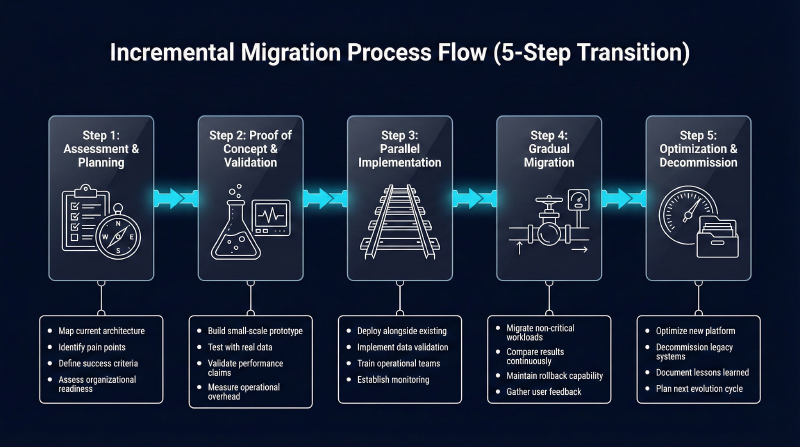
Begin by mapping your current architecture against historical patterns to understand which generation of technology you’re operating and what limitations you’re likely to encounter. Identify whether your systems follow ETL-warehouse patterns, distributed big data approaches, cloud-native designs, or hybrid combinations.
Assess your organization’s position in the adoption lifecycle for emerging technologies. Early-stage platforms offer competitive advantages but require higher risk tolerance and internal expertise. Mature platforms provide stability and ecosystem support but may lack cutting-edge capabilities. Match your adoption timing to organizational risk capacity and competitive requirements.
Evaluate migration paths that preserve existing investments while addressing current limitations. Successful transitions typically happen incrementally, with new capabilities added alongside existing systems rather than wholesale replacements. Design integration points that allow gradual migration of workloads as new platforms prove their value.
Establish success criteria that reflect business outcomes rather than technical metrics alone. Historical examples show that the most successful architectural transitions improve decision-making speed, reduce operational overhead, or enable new capabilities that drive revenue. Technical elegance matters less than business impact.
Plan for the operational changes that accompany architectural shifts. New platforms require different skills, monitoring approaches, and incident response procedures. Invest in training, documentation, and operational readiness before migrating critical workloads. The technology transition is often easier than the organizational adaptation.
Metrics of Adaptability#
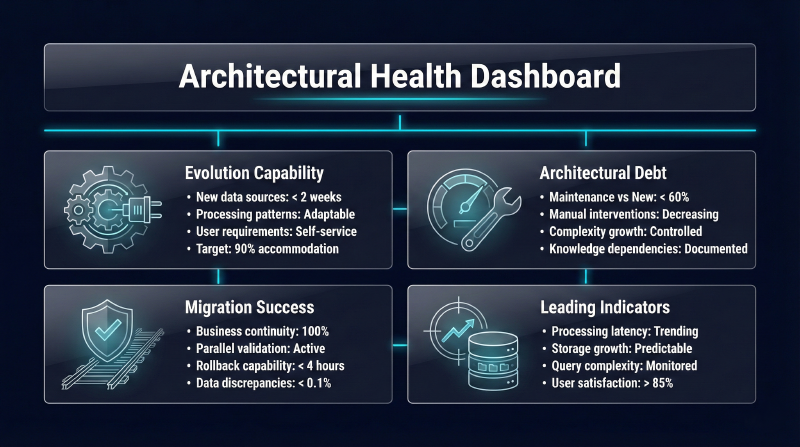
Historical data architecture success is measured through evolution capability rather than static performance metrics. Systems that adapt to changing requirements over decades demonstrate better long-term value than those optimized for specific point-in-time needs. Track how easily your architecture accommodates new data sources, processing patterns, and user requirements.
Architectural debt accumulates when short-term solutions become permanent fixtures. Monitor the ratio of maintenance effort to new capability development. Healthy systems require decreasing operational overhead as they mature, freeing resources for innovation. Watch for increasing complexity, manual intervention requirements, and specialized knowledge dependencies that indicate architectural stress.
Migration success depends on maintaining business continuity while transitioning between systems. Establish parallel processing capabilities that allow validation of new platforms against existing results. Implement rollback procedures that can restore service quickly if migrations encounter unexpected issues. Design data validation processes that catch discrepancies before they affect business decisions.
Leading indicators include processing latency trends, storage growth rates, and query complexity evolution. These metrics help predict when current architectures will reach capacity limits, enabling proactive planning rather than reactive crisis management. Monitor user satisfaction and self-service adoption rates as measures of architectural usability.
For resilience, maintain the ability to operate critical workloads on multiple platforms during transition periods. Design data formats and interfaces that avoid vendor lock-in and enable future migrations. Implement comprehensive monitoring that provides visibility into system health across hybrid environments. The goal is graceful evolution rather than disruptive replacement.
The Cost of Evolution#
Data architecture costs follow predictable patterns across technological generations. Initial implementations typically require significant upfront investment in hardware, software, and expertise. Operating costs then grow with data volume and user adoption until architectural limits force expensive scaling decisions or platform migrations.
The most effective cost management strategy is designing for evolution from the beginning. Architectures that can adapt to changing requirements avoid the periodic wholesale replacements that create the highest expenses. Invest in standards, interfaces, and abstractions that preserve flexibility as underlying technologies change.
Two major risks threaten long-term architectural success. Technology lock-in occurs when systems become dependent on specific vendor implementations or proprietary formats. This creates switching costs that grow over time, reducing negotiating power and limiting future options. Mitigate this risk by prioritizing open standards and maintaining data portability.
Operational complexity represents the second major risk. Each architectural generation introduces new failure modes, monitoring requirements, and expertise needs. Organizations often underestimate the operational overhead of managing hybrid environments during transitions. Combat this by investing in automation, standardization, and cross-training that reduces dependency on specialized knowledge.
Historical examples show that the most expensive architectural decisions are those made without understanding long-term implications. Evaluate new platforms based on total cost of ownership over five to ten years, including migration, training, and operational expenses, rather than initial licensing or infrastructure costs alone.
Building for Change#
If your current architecture requires increasingly complex workarounds to handle new requirements, start planning the next generation before performance becomes critical. Successful migrations happen during periods of stability rather than crisis. Watch for patterns where simple requests require disproportionate effort or where new capabilities consistently take longer to implement than expected.
If you find yourself rebuilding similar data processing logic across multiple platforms, invest in abstraction layers that can evolve with underlying technology. The most durable data engineering work focuses on business logic and data models rather than platform-specific implementations. Monitor how much of your codebase needs to change when migrating between systems.
If stakeholders frequently request capabilities that your current architecture cannot support efficiently, document these gaps as input for architectural planning. The best time to evaluate new platforms is when you have a clear understanding of current limitations and future requirements. Track the business value of delayed or rejected requests due to architectural constraints.
A senior architect once described inheriting a system where every major business initiative required a six-month data infrastructure project before any analysis could begin. The team had optimized for storage efficiency and query performance but created a platform that resisted change. They spent two years building self-service capabilities and flexible data models. The investment paid off when the business could launch new analytics initiatives in weeks rather than months, because the architecture supported evolution rather than just operation.
Common Evolutionary Dead Ends#
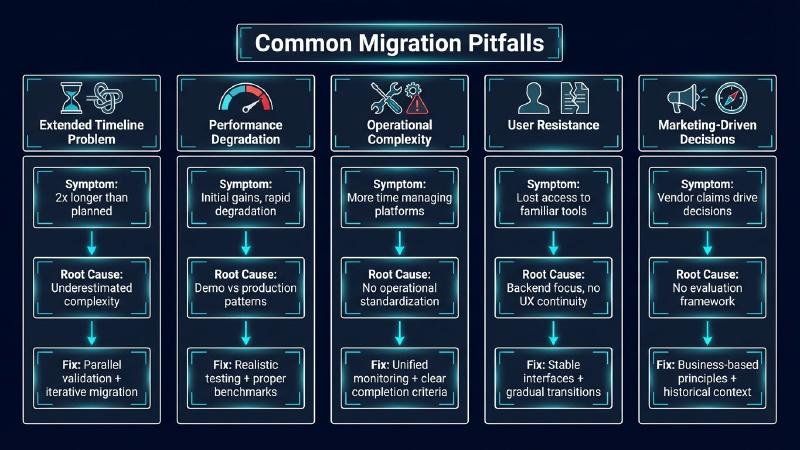
Symptom: Migration projects consistently take twice as long as planned and require significant rework of existing processes. Root cause: Underestimating the complexity of data transformation and business logic migration between platforms. Fix: Implement parallel processing that validates new platform results against existing systems before cutover. Plan for iterative migration of workloads rather than big-bang transitions.
Symptom: New architecture delivers impressive performance improvements initially but degrades rapidly as data volume and user adoption increase. Root cause: Optimizing for demonstration scenarios rather than production workload patterns. Fix: Test new platforms with realistic data volumes, query patterns, and concurrency levels before making migration decisions. Design performance benchmarks that reflect actual usage rather than vendor-provided examples.
Symptom: Teams spend more time managing multiple platforms during transition periods than they did operating the original system. Root cause: Lack of operational standardization and automation across hybrid environments. Fix: Invest in unified monitoring, deployment, and incident response procedures that work across platforms. Establish clear criteria for completing migrations rather than maintaining parallel systems indefinitely.
Symptom: Business users lose access to familiar tools and reports during architectural transitions, creating resistance to change. Root cause: Focusing on backend technology improvements without considering user experience continuity. Fix: Maintain stable interfaces for business users while migrating underlying systems. Implement gradual feature transitions that preserve existing workflows while introducing new capabilities.
Symptom: Architectural decisions are driven by vendor marketing claims rather than actual business requirements and constraints. Root cause: Lack of clear evaluation criteria and historical context for understanding technology trade-offs. Fix: Develop architectural principles based on business needs and organizational capabilities. Evaluate new technologies against these principles rather than feature checklists or performance benchmarks alone.
Conclusion: The Living City#
Data engineering evolution follows predictable patterns driven by changing business requirements, technological capabilities, and economic constraints. Each architectural generation builds on previous innovations while addressing specific limitations, creating new capabilities alongside fresh challenges that drive the next transition.
The urban development mental model helps explain why successful architectures evolve incrementally rather than through wholesale replacement. Like cities that preserve valuable infrastructure while adding new capabilities, effective data platforms build on proven patterns while solving emerging problems. This perspective guides better architectural decisions by focusing on long-term adaptability rather than point-in-time optimization.
Today, you can apply this historical perspective by evaluating your current architecture against the evolutionary patterns we’ve explored. Identify which generation of technology you’re operating, what limitations you’re encountering, and how well your systems support the business requirements that matter most. This assessment reveals whether your architecture is positioned for graceful evolution or heading toward a crisis-driven replacement cycle.
Understanding data engineering’s past provides the context needed to navigate its future. The next article examines how data engineers interface with adjacent roles—analytics engineers, ML engineers, and platform engineers—and where responsibility boundaries create the most value for modern organizations.
What architectural challenges are you facing in your data systems? Connect with me on LinkedIn to share your thoughts.