
Why Linear Pipelines Break at Scale#
The alert fires at 3 AM. Your ML model serving customer recommendations has been returning stale data for six hours. The data engineer on call traces the issue backward through the pipeline: the transformation job failed because the ingestion process changed schema without warning, which happened because the upstream API team deployed a breaking change without coordinating with downstream consumers. By morning, three teams are pointing fingers, customers are seeing irrelevant recommendations, and leadership wants to know why a simple API change broke the entire recommendation system.
This cascade failure reveals the hidden complexity of modern data systems. What appears to be a linear pipeline from source to consumption actually involves multiple stages, each with distinct responsibilities, failure modes, and optimization requirements. Teams that treat data work as a single undifferentiated process struggle with reliability, scalability, and coordination. The solution requires understanding data work as a lifecycle with explicit stages and clear handoffs.
From Reactive Firefighting to Systematic Value#
Organizations that master the data lifecycle achieve predictable delivery times, reliable data quality, and clear accountability when issues arise. They can scale data operations without proportional increases in engineering overhead. Most importantly, they can evolve individual stages independently without disrupting the entire system.
The alternative is data chaos: unpredictable delivery times, unclear ownership boundaries, and brittle systems where small changes create widespread failures. Teams spend more time debugging integration issues than building new capabilities. The lifecycle approach transforms data work from reactive firefighting into systematic value creation with measurable outcomes.
The 5 Stages: Ingest, Transform, Serve, Observe, Govern#
The modern data lifecycle consists of five distinct stages that data flows through from source to consumption: Ingest extracts data from source systems and makes it available for processing. Transform applies business logic, cleaning, and enrichment to create analysis-ready datasets. Serve makes processed data available to consumers through APIs, databases, or files. Observe monitors data quality, system performance, and usage patterns across all stages. Govern manages access control, compliance, and data stewardship throughout the lifecycle.
Each stage has distinct technical requirements, failure modes, and optimization strategies. The boundaries between stages represent explicit handoff points where data contracts, quality expectations, and operational responsibilities transfer between teams or systems.
Not this: The lifecycle is not a rigid sequence that all data must follow completely. Some use cases skip stages, combine them, or implement them in different orders. It’s also not a technology architecture - the same lifecycle can be implemented with batch processing, streaming systems, or hybrid approaches.
The Manufacturing Assembly Line Mental Model#
Think of the data lifecycle like a manufacturing assembly line with quality control stations. Raw materials enter at ingestion, move through transformation workstations where value is added, then proceed to packaging and distribution at the serve stage. Quality inspectors at the observe stage monitor each workstation and the final product. Plant managers at the govern stage ensure safety protocols, worker training, and regulatory compliance across the entire operation.
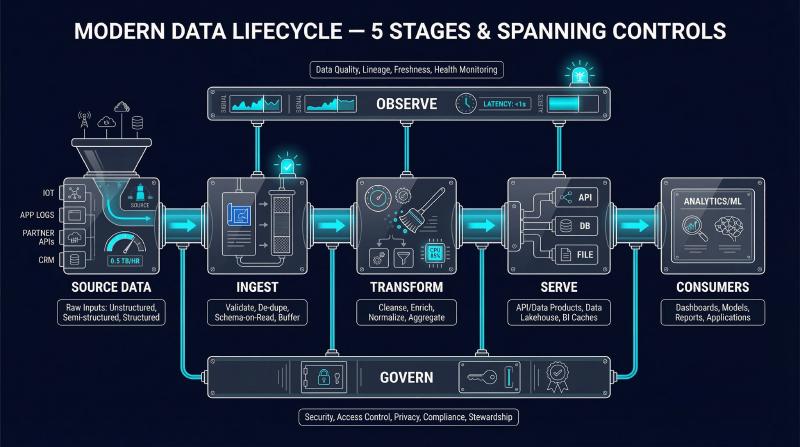
Like manufacturing, each stage can be optimized independently, but the overall system performance depends on coordination between stages. Bottlenecks at any stage affect downstream throughput. Quality problems compound as they move through the system. The most efficient factories design for the entire production flow, not just individual workstations.
When to Formalize Your Data Lifecycle#
Implement explicit lifecycle stages when your data organization has more than two teams working with the same datasets, when data quality issues regularly cascade across multiple systems, or when you need to scale data operations beyond what a single team can manage effectively. The framework becomes essential when business stakeholders need predictable delivery times and clear accountability for data issues.
%%{init: {'theme':'base', 'themeVariables': {'fontSize': '18px', 'fontFamily': 'arial', 'primaryColor': '#e3f2fd', 'primaryTextColor': '#000', 'primaryBorderColor': '#1976d2', 'lineColor': '#1976d2'}, 'flowchart': {'nodeSpacing': 50, 'rankSpacing': 80}}}%%
flowchart TD
    A["Data Lifecycle
    Decision Point"] --> B{"Team
    Complexity?"}

    B -->|"Single team
    Simple flows"| C["Avoid Formal
    Lifecycle"]
    B -->|"Multiple teams
    Shared datasets"| D["Implement
    Lifecycle Stages"]

    D --> E{"Quality Issues
    Cascading?"}

    E -->|"Isolated problems
    Clear ownership"| F["Defer Implementation
    Monitor Trends"]
    E -->|"Cross-system failures
    Unclear accountability"| G["Urgent Implementation
    Start with Critical Flows"]

    G --> H{"Organizational
    Maturity?"}
    F --> H

    H -->|"Stable processes
    Clear boundaries"| I["Full Lifecycle
    Implementation"]
    H -->|"Rapid change
    Unclear processes"| J["Gradual Introduction
    Build Foundations First"]

    style A fill:#1976d2,stroke:#0d47a1,stroke-width:3px,color:#fff
    style B fill:#f57c00,stroke:#ef6c00,stroke-width:2px,color:#fff
    style E fill:#f57c00,stroke:#ef6c00,stroke-width:2px,color:#fff
    style H fill:#f57c00,stroke:#ef6c00,stroke-width:2px,color:#fff

    style C fill:#ffebee,stroke:#d32f2f,stroke-width:2px
    style D fill:#e8f5e8,stroke:#388e3c,stroke-width:2px
    style F fill:#fff3e0,stroke:#f57c00,stroke-width:2px
    style G fill:#e8f5e8,stroke:#388e3c,stroke-width:2px
    style I fill:#e8f5e8,stroke:#388e3c,stroke-width:2px
    style J fill:#fff3e0,stroke:#f57c00,stroke-width:2px
Avoid formal lifecycle boundaries when you have a single small team managing end-to-end data flows, when your data requirements are simple and unlikely to change, or when the overhead of stage coordination exceeds the complexity of your current data operations. Early-stage organizations often benefit from simpler approaches until their data complexity justifies the lifecycle investment.
Defer lifecycle implementation when you lack the organizational maturity to maintain clear stage boundaries, when your technology infrastructure cannot support the required monitoring and observability, or when business requirements change too rapidly to establish stable stage contracts. Focus on building foundational capabilities first, then introduce lifecycle thinking as your operations stabilize.
Case Study: Decoupling Teams for Speed#
Hypothetical example: A financial services company implemented lifecycle thinking after experiencing repeated data quality incidents. They separated their ingestion team (focused on reliable extraction from trading systems) from their transformation team (focused on regulatory calculations) and their serving team (focused on low-latency API performance). Each team developed specialized expertise and could optimize their stage independently. When a trading system changed its data format, only the ingestion team needed to adapt, while downstream stages continued operating normally through established data contracts.
The transformation revealed that most of their previous incidents resulted from unclear handoff points between teams. By making stage boundaries explicit, they reduced cross-team debugging time and improved their ability to isolate and resolve issues quickly. The lifecycle approach also enabled them to scale each stage based on its specific requirements rather than over-provisioning the entire system for peak loads.
This pattern demonstrates how lifecycle thinking clarifies responsibilities and enables independent optimization. Teams can develop deep expertise in their stage while maintaining clear interfaces with adjacent stages. The result is more reliable systems and faster incident resolution.
Blueprint: Mapping Your First Lifecycle#
Start by mapping your current data flows from source to consumption. Document all the transformation steps, storage systems, and handoff points in your most critical data pipeline. Identify which teams or individuals currently own each step and where responsibilities are unclear or overlapping.
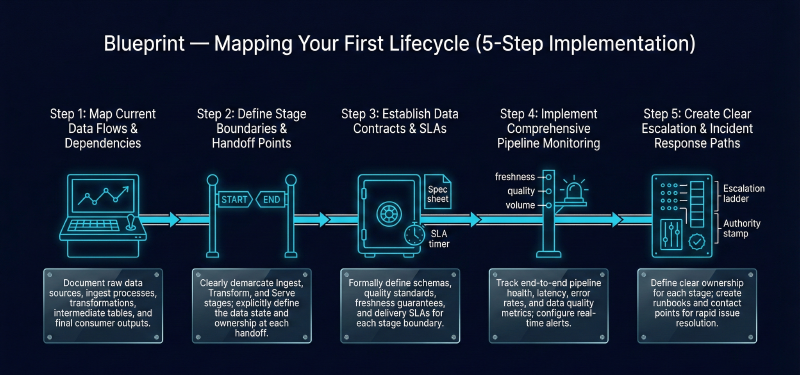
Define explicit stage boundaries based on your current operations. Group related activities into the five lifecycle stages, focusing on natural handoff points where data format, quality expectations, or ownership already change. Don’t force artificial boundaries - adapt the lifecycle model to match your organizational reality.
Establish basic contracts between adjacent stages. Document the data format, quality expectations, and delivery schedule that each stage commits to providing the next stage. Start with simple agreements and evolve them based on operational experience.
Implement monitoring that tracks data flow between stages. Measure data freshness, quality, and volume at each stage boundary. This visibility enables you to identify bottlenecks and quality issues before they cascade downstream.
Create escalation paths for cross-stage issues. Define who makes decisions when stage contracts need to change, how to coordinate deployments that affect multiple stages, and how to handle incidents that span stage boundaries.
Metrics: Tracking Flow Efficiency and Reliability#
Success metrics focus on flow efficiency and reliability across stage boundaries. Measure end-to-end data freshness from source to consumption, typically targeting minutes to hours depending on business requirements. Track data quality scores at each stage boundary to identify where issues originate. Monitor stage-to-stage handoff reliability, aiming for successful transfers in the high nineties.
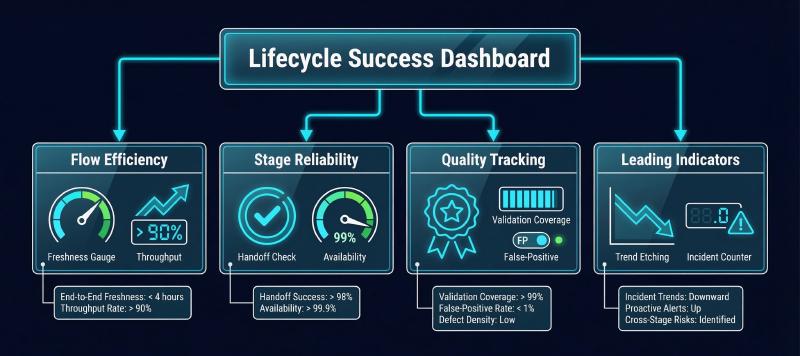
Leading indicators include the time required to resolve cross-stage issues, the frequency of stage contract changes, and the percentage of incidents that affect multiple stages. These metrics reveal whether your lifecycle boundaries are well-designed and whether teams can operate independently.
For anti-fragility, implement circuit breakers that isolate stage failures and prevent cascade effects. Design each stage to degrade gracefully when upstream stages experience issues, using cached data or alternative sources when possible. Maintain rollback capabilities that can restore previous stage configurations without affecting other stages.
The Cost of Coordination vs. The Price of Chaos#
The primary cost drivers are stage coordination overhead, duplicate data storage between stages, and monitoring infrastructure across the lifecycle. Teams often underestimate the operational complexity of maintaining clear stage boundaries and the tooling required to track data flow between stages.
Key cost levers include shared infrastructure between stages, automated stage handoffs that reduce manual coordination, and lifecycle-aware data retention policies that avoid storing the same data at multiple stages indefinitely. Design stage boundaries to minimize data movement and transformation costs while maintaining clear ownership.
The biggest risk is creating artificial stage boundaries that don’t match your organizational structure or technical constraints. Poorly designed boundaries increase coordination overhead without providing the benefits of specialized optimization. Another significant risk is implementing lifecycle thinking without the monitoring infrastructure to track data flow between stages, which creates accountability gaps rather than clarity.
Mitigate these risks by starting with natural boundaries that already exist in your organization and gradually formalizing them rather than imposing an abstract lifecycle model. Invest in observability infrastructure before creating complex stage interactions.
Advanced Optimization: Success Patterns#
If you’re implementing streaming systems, align stage boundaries with natural event processing boundaries rather than forcing batch-oriented lifecycle concepts onto stream processing. When stage performance requirements conflict, optimize for the most constrained stage first, then design other stages to accommodate those constraints. If your serve stage requires sub-second latency but your transform stage needs complex processing, design the transformation to pre-compute results rather than forcing real-time computation.
Monitor stage boundary health more closely than individual stage performance. A transformation job that runs slowly but reliably causes fewer problems than inconsistent handoffs between stages. Design your alerting to detect contract violations between stages before they affect end users.
Common Anti-Patterns and Fixes#
Symptom: Teams spend more time coordinating between stages than working on their core responsibilities. Root cause: Stage boundaries that don’t align with natural team structures or technical constraints. Fix: Redesign boundaries to match existing team ownership and expertise. Combine stages that require frequent coordination or split stages where single teams manage multiple distinct responsibilities.
Symptom: Data quality issues are discovered late in the lifecycle, requiring expensive rollbacks and reprocessing. Root cause: Quality validation concentrated at the serve stage rather than distributed throughout the lifecycle. Fix: Implement quality checks at each stage boundary that validate the specific transformations and business logic applied at that stage. Design early stages to fail fast when quality issues are detected.
Symptom: Individual stages perform well in isolation but end-to-end data delivery is unreliable or slow. Root cause: Optimizing stages independently without considering lifecycle flow and dependencies. Fix: Establish end-to-end performance targets that drive stage-level optimization decisions. Implement lifecycle-aware monitoring that tracks data flow velocity and identifies bottlenecks across stage boundaries.
Symptom: New data sources take weeks to integrate because they require changes across multiple stages. Root cause: Rigid stage implementations that cannot accommodate schema evolution or new data patterns. Fix: Design stages with extensibility in mind, using configuration-driven approaches that allow new data sources to be onboarded without code changes. Implement schema evolution strategies that maintain backward compatibility across stage boundaries.
Next Steps: From Pipeline to Lifecycle#
The manufacturing assembly line mental model reveals why successful data organizations think in terms of lifecycle stages rather than monolithic pipelines. Each stage can be optimized for its specific requirements while maintaining clear contracts with adjacent stages. This approach enables specialization, independent scaling, and faster incident resolution.
Today, you can start by documenting the handoff points in your most critical data flow. Identify where data format changes, where ownership transfers between teams, and where quality expectations shift. These natural boundaries become the foundation for lifecycle thinking that will scale with your organization.
The next article explores how batch, micro-batch, and streaming paradigms implement these lifecycle concepts differently, helping you choose the right processing model for each stage of your data operations.
What data lifecycle challenges are you facing? Connect with me on LinkedIn to share your thoughts.