
The High Cost of Choosing the Wrong Vehicle#
The alert fires at 3 AM. Customer transactions are failing because the fraud detection model is working with stale feature data from yesterday’s batch run. Meanwhile, the real-time streaming pipeline that was supposed to solve this problem has been down for six hours, killed by a memory leak in the stateful processing logic. The team scrambles between two bad choices: accept the business risk of delayed fraud detection or restart a complex streaming system they don’t fully understand.
This scenario plays out weekly across engineering teams who chose their processing paradigm based on aspirational requirements rather than operational reality. The choice between batch, micro-batch, and streaming isn’t just about latency—it’s about matching your team’s complexity tolerance with your business’s actual timing needs. Most teams overestimate their latency requirements and underestimate streaming complexity, leading to over-engineered solutions that create more problems than they solve.
From Operational Surprises to Predictable Costs#
Getting processing paradigm choice right means your data systems become predictable cost centers rather than operational surprises. Teams that match paradigms to requirements see data freshness that meets business SLAs without over-engineering, operational complexity that stays within team capabilities, and cost structures that scale predictably with data volume.
When paradigm choice aligns with reality, data engineering becomes a force multiplier rather than a bottleneck. Teams spend time building features instead of debugging distributed state management, and business stakeholders get reliable data delivery they can plan around. The north-star metrics are latency-to-business-value, operational complexity burden, and total cost of ownership including both infrastructure and engineering time.
The 3 Paradigms: Bus, Shuttle, Taxi#
Batch processing handles data in discrete, scheduled chunks with high throughput and eventual consistency. Think nightly ETL jobs that process the entire day’s transactions in one operation. Micro-batch processing splits data into small, frequent batches—processing every few minutes or seconds with simplified architecture compared to true streaming. Streaming processing handles data continuously as individual events arrive, maintaining stateful computations with low latency but higher operational complexity.
The key distinction lies in how data is collected and processed. Batch systems accumulate data over time periods and process it all at once. Micro-batch systems process small collections of data at regular intervals. Streaming systems process each data point as it arrives, maintaining continuous state and enabling immediate responses.
Not this: This isn’t about specific tools or vendors. Spark can do batch, micro-batch, or streaming. Kafka can support all three paradigms. We’re focused on the processing model, not the implementation technology. Also not covered: real-time analytics queries against stored data, which is a serving pattern rather than a processing paradigm.
The Transportation System Mental Model#
Think of data processing paradigms as different transportation systems for moving people through a city. Batch processing is like buses—high capacity, scheduled routes, efficient for moving lots of people but with fixed departure times. Micro-batch is like shuttle services—smaller vehicles running more frequently, balancing capacity with convenience. Streaming is like individual taxis—immediate response to demand, personalized routing, but higher per-passenger cost and complexity.
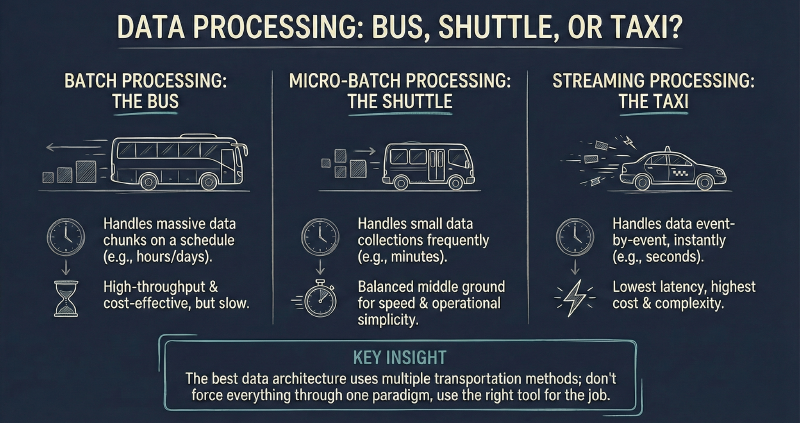
Just as you wouldn’t use taxis for rush-hour commuting or buses for emergency transport, each data processing paradigm has natural fit scenarios. The key insight: match the transportation method to the journey requirements, not the other way around. This transportation analogy will guide our decision framework and help explain why hybrid approaches often work best in practice.
Decision Framework: Latency vs. Complexity#
Choose your processing paradigm by evaluating three key dimensions: business latency tolerance, operational complexity capacity, and data volume characteristics. This framework helps you match paradigm to reality rather than aspirations.
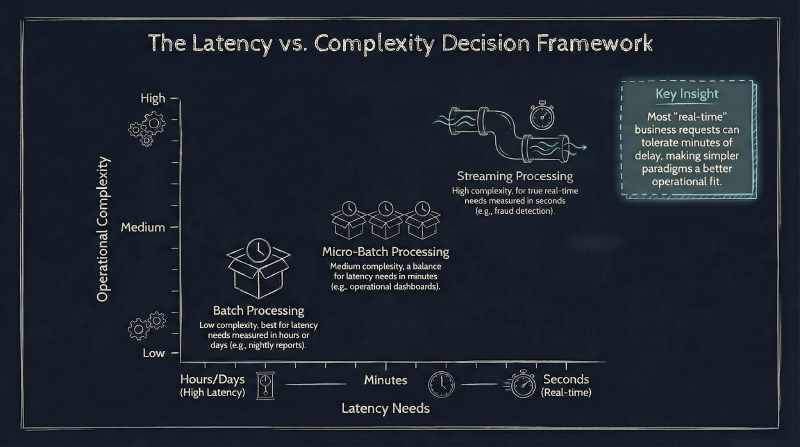
Step 1: Audit Real Business Requirements Ask not what stakeholders want, but what business decisions actually change based on data freshness. Document the real tolerance windows, not aspirational ones. Most “real-time” requirements turn out to be “within an hour” when examined closely.
Step 2: Assess Team Capabilities Streaming systems fail in complex ways that require deep distributed systems knowledge to debug. Batch systems fail more predictably but can create business continuity risks if recovery takes too long. Micro-batch systems offer a middle ground with manageable failure modes.
Step 3: Match Paradigm to Journey If latency requirements are measured in hours, choose batch. If measured in minutes, consider micro-batch. If measured in seconds, evaluate streaming carefully against your team’s operational capabilities. The decision matrix prioritizes operational reality over technical elegance.
Case Study: Right-Sizing the Ride#
Hypothetical example: A financial services company initially built their transaction monitoring as a streaming system because “real-time” sounded important. After six months of production incidents caused by complex windowing logic and state management, they switched to micro-batch processing every thirty seconds. Customer experience remained identical—fraud alerts still arrived within a minute—but operational overhead dropped dramatically. The lesson: business requirements often have more latency tolerance than initial specifications suggest.
Hypothetical example: An e-commerce platform runs three processing paradigms simultaneously for different use cases. Batch processing handles nightly inventory reconciliation and financial reporting. Micro-batch updates product recommendations every five minutes. Streaming powers real-time inventory deduction during checkout to prevent overselling. Each paradigm serves its natural purpose without forcing artificial requirements.
These examples demonstrate that paradigm choice should follow the transportation analogy—use the right vehicle for each journey rather than trying to solve every problem with the same approach. Mature data platforms often use multiple paradigms rather than forcing everything through one approach. The pattern: segment workloads by actual requirements and operational constraints, not by technical preferences.
Blueprint: Auditing Your Routes#
Start by auditing your current latency requirements with business stakeholders. Ask not what they want, but what business decisions actually change based on data freshness. Document the real tolerance windows, not aspirational ones. Most “real-time” requirements turn out to be “within an hour” when examined closely.
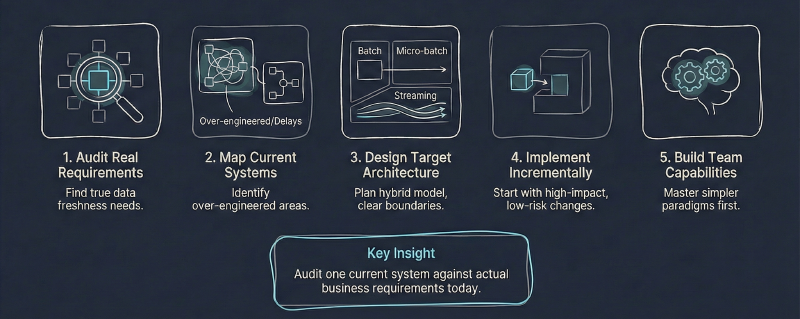
Map your existing data flows to the transportation analogy. Identify which processes are currently over-engineered with streaming when micro-batch would suffice, and which batch processes create genuine business delays. Look for patterns where the same data serves multiple use cases with different latency needs.
Design your target architecture with paradigm boundaries clearly defined. Plan batch processing for high-volume analytical workloads, micro-batch for operational dashboards and monitoring, and streaming only for truly latency-sensitive business logic. Establish clear handoff points between paradigms rather than trying to stretch one approach across all use cases.
Implement changes incrementally, starting with the highest-impact, lowest-risk paradigm shifts. Moving from streaming to micro-batch typically reduces operational burden immediately. Moving from batch to micro-batch usually improves stakeholder satisfaction with minimal complexity increase.
Build operational capabilities before adding complexity. Ensure your team can reliably operate batch and micro-batch systems before introducing streaming. Streaming systems require expertise in distributed state management, exactly-once processing semantics, and complex failure recovery scenarios.
Metrics: Tracking Schedule Reliability and Lag#
Track end-to-end latency from data arrival to business availability, not just processing time. Batch systems should measure schedule reliability and throughput consistency. Micro-batch systems need latency distribution monitoring and backlog depth tracking. Streaming systems require lag monitoring, checkpoint health, and state size growth patterns.
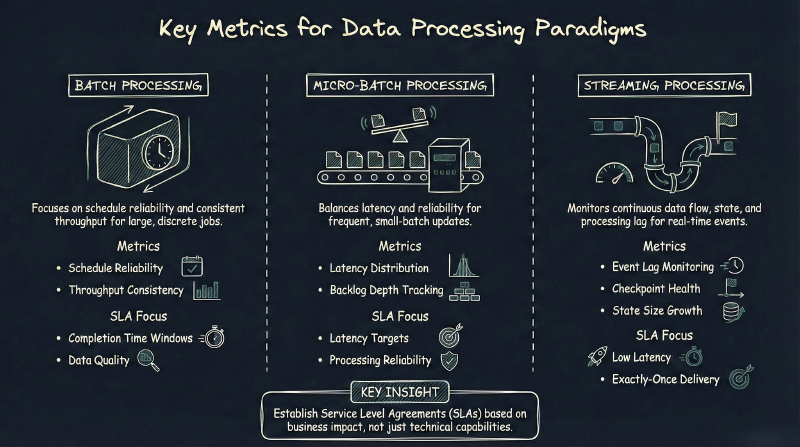
Establish SLAs based on business impact rather than technical capabilities. Batch processing SLAs typically focus on completion time windows and data quality thresholds. Micro-batch SLAs balance latency targets with processing reliability. Streaming SLAs must account for both latency and exactly-once delivery guarantees where business logic requires it.
Build anti-fragility through graceful degradation patterns. Batch systems should support partial reprocessing and incremental recovery. Micro-batch systems need backpressure handling and automatic batch size adjustment. Streaming systems require circuit breakers, dead letter queues, and the ability to fall back to batch processing during extended outages.
The Economics of Throughput vs. Latency#
Batch processing offers the lowest cost per unit of data processed but can create expensive delays when business decisions wait for scheduled runs. The primary cost drivers are compute resources during processing windows and storage for intermediate results. Control costs through efficient scheduling, resource right-sizing, and data lifecycle management.
Micro-batch processing typically costs more per unit than batch but less than streaming, with the added benefit of predictable resource usage patterns. Costs scale with processing frequency and data volume. Optimize by tuning batch sizes and processing intervals based on actual business requirements rather than technical defaults.
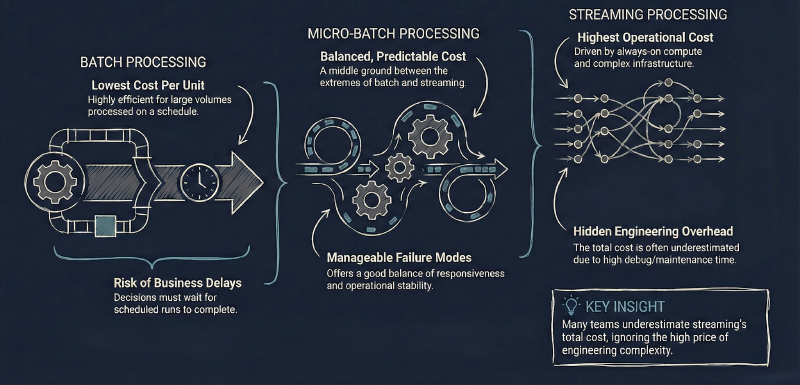
Streaming processing has the highest operational costs due to continuous resource consumption and complex infrastructure requirements. The major cost drivers include always-on compute resources, state storage, and engineering time for operational complexity. Many teams underestimate the total cost of ownership, focusing only on infrastructure while ignoring the engineering overhead.
Risk mitigation starts with honest assessment of team capabilities. Streaming systems fail in complex ways that require deep distributed systems knowledge to debug. Batch systems fail more predictably but can create business continuity risks if recovery takes too long. Micro-batch systems offer a middle ground with manageable failure modes and reasonable recovery times.
Advanced Optimization: Hybrid Architectures#
When designing hybrid architectures, establish clear paradigm boundaries at the data model level. Avoid systems that try to be both batch and streaming simultaneously. If you’re considering streaming, build the batch version first to understand the business logic. Streaming adds complexity that obscures fundamental processing errors.
When evaluating latency requirements, measure the time between data availability and actual business action. Many “urgent” dashboards sit unviewed for hours. If your streaming system requires complex windowing or joins, consider whether micro-batch with slightly higher latency would simplify the implementation dramatically.
Common Anti-Patterns and Fixes#
Symptom: Your streaming system constantly runs out of memory or falls behind during peak traffic. Root cause: Complex stateful operations that accumulate data faster than they can process it, often due to unbounded state growth or inefficient windowing logic. Fix: Redesign with bounded state, implement proper watermarking, or consider micro-batch processing for the same business outcome with predictable resource usage.
Symptom: Stakeholders complain that batch processing is too slow, but streaming seems like overkill for the use case. Root cause: False binary thinking that ignores micro-batch as a middle ground option. Fix: Implement micro-batch processing with appropriate intervals—often every few minutes provides the responsiveness stakeholders need without streaming complexity.
Symptom: Your team spends more time debugging data processing infrastructure than building business features. Root cause: Choosing paradigms based on technical appeal rather than operational capabilities and business requirements. Fix: Audit your current systems against the transportation analogy—use simpler paradigms where they meet business needs and reserve complexity for cases that genuinely require it.
Symptom: Data processing costs keep growing faster than data volume. Root cause: Over-engineering with streaming or micro-batch where batch processing would suffice, leading to continuous resource consumption for workloads that could run efficiently on schedules. Fix: Segment your workloads by actual latency requirements and move appropriate processes back to batch scheduling.
Symptom: Business users lose confidence in data freshness because processing paradigms don’t match their mental models. Root cause: Technical teams choosing paradigms without understanding how business stakeholders actually use the data. Fix: Map data consumption patterns to processing paradigms. Align technical implementation with business workflow timing rather than forcing users to adapt to technical constraints.
Next Steps: Auditing Your Fleet#
The transportation analogy provides a durable framework for processing paradigm decisions: match the vehicle to the journey requirements. Most teams benefit from a hybrid approach using batch for high-volume analytics, micro-batch for operational monitoring, and streaming only where seconds matter for business outcomes.
The key decision you can make today is auditing one current system against its actual business requirements. You’ll likely find opportunities to simplify without sacrificing value. Start with your most operationally complex system and trace its latency requirements back to real business impact. This exercise often reveals that streaming complexity isn’t justified by business needs.
This paradigm choice foundation prepares you for understanding how different business functions naturally align with different processing patterns. The next article in our series explores “Data Domains & Use-Cases,” where we’ll examine why understanding your data’s ultimate purpose should drive architectural decisions from the start.
What processing paradigm challenges are you facing? Connect with me on LinkedIn to share your thoughts.