
The Chaos of Monolithic Data#
The Slack message arrived at 3 AM: “Dashboard is showing zero revenue for the last hour, but customers are definitely buying.” The on-call engineer’s heart sank as they realized the real-time analytics pipeline had diverged from the batch system feeding the executive dashboard. What started as a simple request to “add real-time metrics” had become a nightmare of conflicting data domains, each with different freshness requirements, consistency guarantees, and failure modes.
The marketing team needed sub-second activation data for personalization, the ML team required point-in-time correctness for training, and the finance team demanded exactly-once processing for revenue reporting. Three domains, three architectures, one very tired engineer trying to make sense of why the same data looked different everywhere.
This scenario plays out daily across data teams because we often treat “data” as monolithic when it’s actually serving fundamentally different use-cases with incompatible requirements. Understanding these domain boundaries isn’t just about technical architecture—it’s about preventing the operational chaos that comes from forcing all consumption patterns through the same pipes.
From Architectural Chaos to Domain Clarity#
Understanding data domains transforms how you architect systems because each domain has distinct latency, consistency, and reliability requirements that cascade through every technical decision. When you align your data architecture with actual consumption patterns, you stop over-engineering batch systems for real-time needs and under-engineering streaming systems for analytical workloads.
The payoff is architectural clarity that prevents the 3 AM incidents described above. Teams that map domains to infrastructure see faster feature delivery, lower operational overhead, and fewer data quality incidents because they’ve matched technical capabilities to business requirements rather than forcing all use-cases through the same pipes.
The north-star metrics are domain-specific SLAs that align with business value, reduced cross-domain incidents, and infrastructure costs that scale predictably with actual usage patterns rather than theoretical peak loads.
The 5 Key Domains: BI, ML, Real-Time, Reverse ETL, Activation#
Data domains represent distinct consumption patterns that drive different architectural requirements. Business Intelligence focuses on historical analysis and aggregated reporting with tolerance for eventual consistency and batch processing schedules. Machine Learning requires feature engineering pipelines with point-in-time correctness, reproducibility, and often complex feature stores. Real-time operational systems need low-latency decision support with acceptable approximations and high availability. Reverse ETL pushes processed insights back to operational systems for activation with reliability guarantees. Data activation encompasses customer personalization, marketing automation, and operational workflows that require fresh data to drive business processes.
Each domain has fundamentally different performance characteristics: BI optimizes for query flexibility and historical accuracy, ML prioritizes reproducibility and feature consistency, real-time systems focus on latency and availability, reverse ETL emphasizes reliability and downstream system compatibility, and activation systems balance freshness with operational stability.
Not this: Data domains aren’t organizational boundaries, storage locations, or technology choices. A single team might serve multiple domains, and a single dataset might flow through several domain-specific processing paths with different SLAs and consistency requirements. This isn’t about data governance or access control—it’s about matching technical architecture to consumption patterns.
The Transportation Network Mental Model#
Think of data domains as different transportation networks serving the same city. The subway system optimizes for high throughput and predictable schedules, moving large numbers of people efficiently but with fixed stops and longer travel times—like BI systems processing large datasets on reliable schedules. The taxi network prioritizes point-to-point speed and flexibility, handling urgent trips with higher cost per passenger—similar to real-time operational systems. The bus system balances coverage and cost, serving areas the subway can’t reach with acceptable speed—like ML systems providing broad feature coverage with reasonable latency. Emergency services get dedicated lanes and priority signals because lives depend on response time—analogous to activation systems where business impact demands reliability.
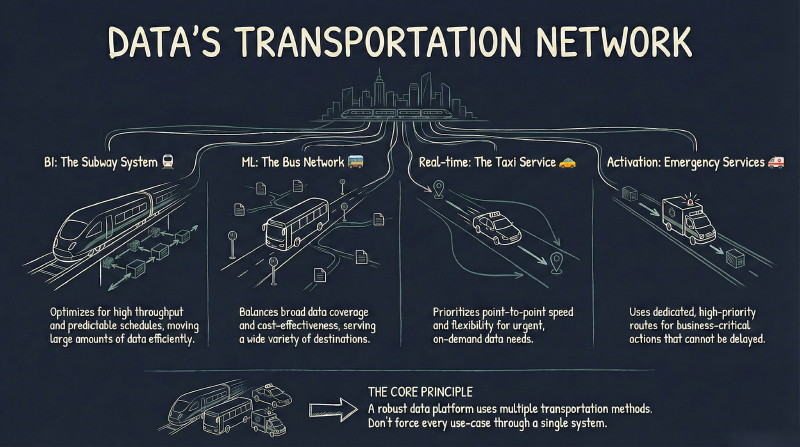
Each network serves the same population but with fundamentally different performance characteristics, infrastructure requirements, and cost structures. Similarly, your data architecture needs different “transportation networks” for different consumption patterns, each optimized for its specific requirements rather than trying to force all traffic through a single system.
Decision Framework: Matching Needs to Infrastructure#
Choose your domain architecture by evaluating three key dimensions: consumption pattern requirements, operational complexity tolerance, and business impact of failures. This framework helps you match infrastructure to actual usage rather than aspirational requirements.
Step 1: Map Use Cases to Domains Start by cataloging your current data use cases and mapping them to the five core domains. Document the actual latency requirements, not the aspirational ones. Most “real-time” requirements turn out to be “within an hour” when examined closely.
Step 2: Assess Current Architecture Mismatches Identify where your current architecture mismatches domain needs, focusing on the highest-impact gaps. Look for over-engineered streaming solutions serving BI needs and under-engineered batch systems trying to serve real-time requirements.
Step 3: Design Domain-Specific Flows Plan domain-specific data flows while establishing clear integration points where domains need to share data. Avoid trying to stretch one domain’s architecture to serve another’s requirements.
Case Study: Splitting the Monolith#
Hypothetical example: A retail company initially built everything on their data warehouse, pushing real-time inventory updates through nightly batch jobs. When they launched personalization features, customers saw recommendations for out-of-stock items because the ML models trained on stale inventory data. The fix required splitting their architecture: streaming inventory updates for real-time features, with reconciliation jobs ensuring the warehouse stayed consistent for financial reporting.
Hypothetical example: A financial services firm tried to use their real-time fraud detection infrastructure for regulatory reporting. The streaming system’s eventual consistency guarantees couldn’t meet audit requirements for exact transaction counts. They learned to maintain separate domain-specific pipelines: streaming for fraud detection with acceptable approximations, and batch processing for compliance reporting with strong consistency guarantees.
These examples demonstrate that paradigm choice should follow the transportation analogy—use the right vehicle for each journey rather than trying to solve every problem with the same approach. The pattern: segment workloads by actual requirements and operational constraints, not by technical preferences or organizational convenience.
Blueprint: Mapping Your Domains#
Start by auditing your current use-cases and mapping them to the five core domains: BI, ML, real-time operational, reverse ETL, and activation. Document the actual latency requirements, not the aspirational ones. Interview stakeholders about what business decisions actually change based on data freshness.
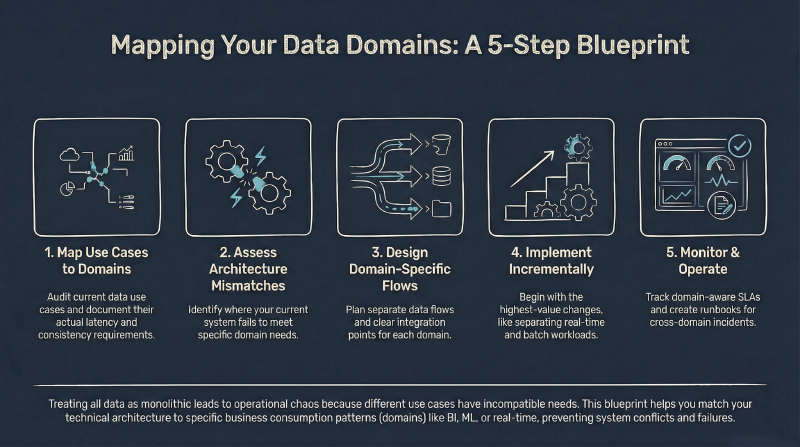
Identify where your current architecture mismatches domain needs, focusing on the highest-impact gaps. Look for patterns where the same data serves multiple use cases with different latency needs—these are prime candidates for domain-specific processing paths.
Design domain-specific data flows while planning integration points where domains need to share data. Establish clear data contracts that specify which domains each dataset serves and what guarantees it provides. Avoid trying to stretch one domain’s architecture to serve another’s requirements.
Implement the highest-value domain improvements first, typically starting with separating real-time from batch workloads. Build monitoring and alerting that’s domain-aware, tracking different SLAs for different consumption patterns. Create runbooks for cross-domain incidents, because failures often cascade across domain boundaries.
Metrics: Domain-Specific SLAs and Health#
Success metrics vary dramatically by domain. BI systems track data freshness measured in hours, query performance for large aggregations, and consistency between different reporting views. ML systems monitor feature drift, training data staleness, and point-in-time correctness for reproducible experiments. Real-time systems focus on end-to-end latency, throughput under load, and availability during peak traffic. Reverse ETL tracks sync success rates, downstream system health, and data quality at activation points.
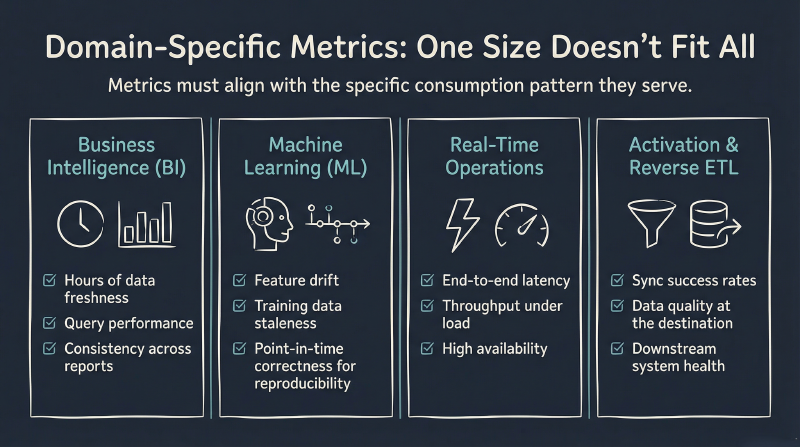
Leading indicators include cross-domain data quality checks, upstream system health that affects multiple domains, and resource utilization trends that predict capacity issues. Failure signals manifest differently across domains: BI failures show up as stale dashboards or inconsistent reports, ML failures appear as model performance degradation, real-time failures trigger immediate user-facing issues.
For resilience, implement domain-specific circuit breakers that can isolate failures without cascading across your entire data platform. When real-time systems fail, fall back to the last known good state rather than propagating errors to downstream activation systems.
The Economics of Multimodal Data Architecture#
Cost drivers differ significantly across domains. BI systems optimize for storage efficiency and query performance, making compute costs predictable but storage costs variable with data retention. ML systems create expensive compute spikes during training and feature engineering, with costs tied to experimentation velocity. Real-time systems require always-on infrastructure with costs scaling with peak load rather than average utilization. Reverse ETL and activation systems generate costs in downstream operational systems, often outside your direct control.
The biggest cost lever is right-sizing infrastructure for actual domain requirements rather than over-provisioning for theoretical peak loads. Real-time systems rarely need the same compute power as ML training jobs, and BI systems don’t need the same availability guarantees as customer-facing activation systems.
Primary risks include domain coupling that creates cascading failures, inconsistent data across domains that breaks business logic, and operational complexity from managing multiple infrastructure patterns. Mitigate these through clear domain boundaries, automated reconciliation between domains, and standardized operational practices across different infrastructure types.
The hidden cost is engineering time spent on cross-domain integration and troubleshooting. Teams often underestimate the operational overhead of maintaining multiple domain-specific architectures, focusing only on infrastructure costs while ignoring the engineering complexity.
Advanced Optimization: Bridges Between Domains#
When debugging cross-domain incidents, start by examining the bridges between domains rather than the domains themselves. Most data inconsistencies occur in the integration points where data flows from one domain’s processing paradigm to another’s consumption pattern.
If ML teams complain about data freshness, check whether they actually need real-time features or just more frequent batch updates. Many ML use cases can tolerate hourly or even daily feature updates without impacting model performance, but teams often assume they need streaming infrastructure.
If activation systems are unreliable, look at the data contracts between domains rather than just the infrastructure. Activation failures often stem from upstream domains not providing the consistency guarantees that downstream business logic requires.
Common Anti-Patterns and Fixes#
Symptom: Real-time dashboards show different numbers than batch reports. Root cause: Trying to achieve perfect consistency across fundamentally different processing paradigms. Fix: Accept eventual consistency and implement reconciliation monitoring that alerts on significant discrepancies rather than trying to eliminate them entirely.
Symptom: ML models perform poorly in production despite good training metrics. Root cause: Training on batch data that doesn’t match real-time feature serving patterns, creating online-offline parity issues. Fix: Implement feature stores that serve both training and inference with the same logic, ensuring consistency across ML domain boundaries.
Symptom: Activation systems frequently fail or deliver stale data. Root cause: Treating activation as an afterthought rather than a first-class domain with its own reliability requirements. Fix: Design activation pipelines with the same rigor as customer-facing services, including circuit breakers and fallback strategies.
Symptom: Data platform costs are unpredictable and growing faster than usage. Root cause: Using the same infrastructure patterns for all domains regardless of their actual requirements. Fix: Right-size infrastructure for each domain’s specific latency, consistency, and availability needs rather than over-provisioning everything for worst-case scenarios.
Symptom: Teams spend more time debugging data infrastructure than building business features. Root cause: Choosing domain architectures based on technical appeal rather than operational capabilities and business requirements. Fix: Audit your current systems against the transportation analogy—use simpler approaches where they meet business needs and reserve complexity for cases that genuinely require it.
Next Steps: Building Your Network#
The transportation network mental model applies beyond just technical architecture. When you understand that different data domains have fundamentally different requirements, you can make better decisions about tooling, team structure, and operational practices. A single data platform doesn’t mean a single architecture any more than a single city means a single transportation system.
The decision you can make today is auditing one critical use-case and asking whether your current architecture actually matches its domain requirements. Start with the use-case that generates the most operational pain or business impact when it fails. You’ll likely find opportunities to simplify or enhance based on actual consumption patterns.
Understanding data domains sets the foundation for making architectural decisions that align with business value rather than technical convenience. This domain-driven approach ensures your data infrastructure serves actual business needs rather than forcing business processes to adapt to technical constraints.
What data domain challenges are you facing? Connect with me on LinkedIn to share your thoughts.