
The Growing Pains of Data Cities#
The engineering team at a growing fintech company faces a familiar crossroads. Their traditional data warehouse handles structured transaction data beautifully, delivering sub-second analytics for regulatory reporting. But now they need to process unstructured customer support logs, real-time fraud detection signals, and machine learning features—all while keeping costs predictable. The warehouse that served them well for three years suddenly feels like a constraint rather than an enabler.
This tension between structured performance and flexible innovation has driven the most significant architectural shifts in data engineering over the past two decades. Each generation of data architecture emerged not from theoretical advancement, but from teams hitting real walls with existing approaches. Understanding why these shifts happened—and what fundamental principles persist across all architectures—determines whether your next architectural decision accelerates or constrains your team’s capabilities for years to come.
The stakes are immediate: teams making architectural decisions today will live with those choices for the next 3-5 years. Choose wrong, and you’ll spend more time fighting your architecture than building features. Choose right, and your data systems become force multipliers that enable rapid business growth.
From Strict Zoning to Organic Growth#
Getting data architecture evolution right means your team can adapt to new use cases without rebuilding foundational systems. Teams that understand the driving forces behind architectural shifts make decisions that scale with business needs rather than against them. They recognize when to leverage existing investments and when migration becomes inevitable.
The payoff extends beyond technical flexibility. Organizations that choose architectures aligned with their actual workload patterns see measurably better outcomes in the north-star metrics that matter: data freshness improves when storage and compute can scale independently, cost predictability increases when you pay for what you use, and system reliability strengthens when you can isolate workloads without sacrificing governance.
The wrong architectural choice, however, creates years of technical debt and limits your ability to respond to changing business requirements. Teams end up maintaining multiple incompatible systems, struggling with data consistency across platforms, and burning engineering cycles on infrastructure instead of business features. The business impact is measurable: slower time-to-market for data products, higher operational costs, and reduced confidence in data-driven decisions.
The 3 Eras: Warehouses, Lakes, Lakehouses#
Data architecture evolution refers to the systematic progression from traditional data warehouses through data lakes to modern lakehouses, driven by changing requirements for data variety, volume, velocity, and cost efficiency. Each architectural generation represents a response to specific limitations of its predecessor while introducing new capabilities and trade-offs.
Traditional data warehouses optimize for structured data analytics with schema-on-write approaches and tightly coupled storage and compute. They excel at consistent performance for known query patterns but struggle with data variety and cost efficiency at scale. Think MS SQL handling your core business reporting.
Data lakes prioritize flexibility and cost efficiency through schema-on-read patterns and object storage. They handle any data type cost-effectively but require more sophisticated tooling for performance and governance. Think S3 with Spark processing raw JSON, Parquet files, and machine learning datasets.
Lakehouses attempt to combine the performance and governance of warehouses with the flexibility and economics of lakes through metadata layers and compute engines that operate directly on open formats. Think Databricks Delta Lake or Apache Iceberg providing ACID transactions on object storage.
Not this: This evolution is not about replacing one architecture entirely with another, nor is it a linear progression where newer always means better. Many successful organizations run hybrid architectures that leverage the strengths of multiple approaches. The evolution also doesn’t eliminate the fundamental challenges of data governance, quality, and operational complexity—it redistributes them across different system components.
The Urban Planning Mental Model#
Think of data architecture evolution like urban development patterns. Traditional data warehouses resemble planned cities with strict zoning laws—everything has its designated place, movement follows prescribed routes, and performance is optimized for known traffic patterns. Data lakes are like sprawling metropolitan areas where different districts develop organically, offering flexibility and lower costs but requiring more coordination to navigate efficiently.
Lakehouses represent smart city planning that combines the best of both approaches. They maintain the governance and performance characteristics of planned cities while offering the flexibility and economic efficiency of organic growth. Like smart cities, they achieve this through sophisticated infrastructure layers—metadata management, query optimization, and transaction coordination—that operate transparently beneath the surface.
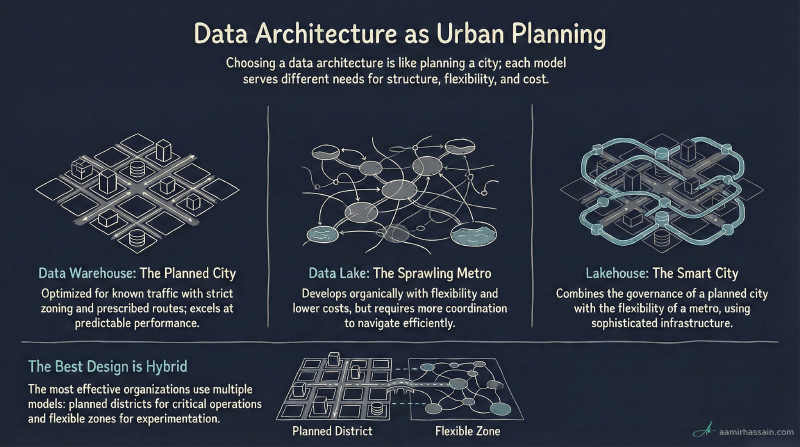
This mental model helps evaluate architectural decisions by asking: What kind of “city” does your organization need? Are you optimizing for predictable performance with known workloads, or do you need flexibility to accommodate rapid growth and changing requirements? The answer guides whether you invest in warehouse optimization, lake flexibility, or lakehouse convergence.
Decision Framework: Choosing Your City Plan#
Choose your data architecture by evaluating three key dimensions: workload diversity, cost sensitivity, and operational maturity. This framework helps you match architecture to reality rather than aspirations.
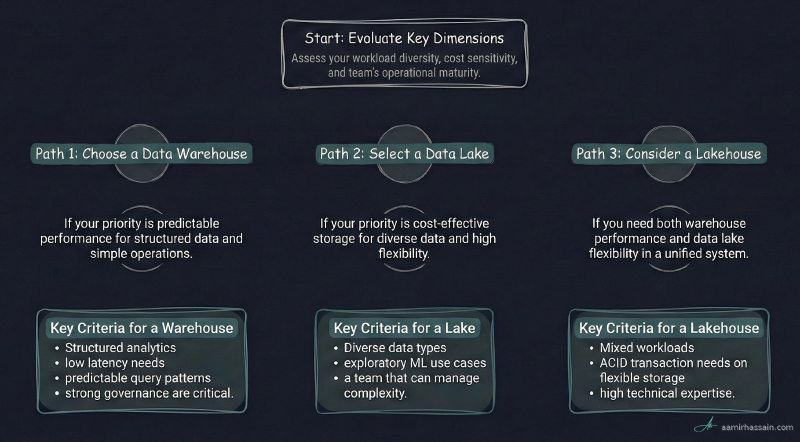
Choose traditional data warehouses when your workloads are primarily structured analytics with predictable query patterns, your team values operational simplicity over flexibility, and performance requirements justify higher costs. Warehouses excel when data governance is critical, query latency must be consistently low, and your organization has established processes around schema design and ETL pipelines.
Select data lakes when you need to store diverse data types cost-effectively, your use cases include exploratory analytics and machine learning, and your team can manage the operational complexity of schema-on-read systems. Lakes work best when storage costs dominate your budget, you’re experimenting with new data sources, and you can tolerate higher query latency in exchange for flexibility.
Consider lakehouses when you need both warehouse performance and lake flexibility, your organization runs diverse workloads that benefit from unified storage, and you have the technical expertise to manage more complex metadata and compute layers. Lakehouses make sense when you’re already operating both warehouses and lakes, when governance requirements demand ACID transactions on flexible storage, or when you’re building new systems that need to support both structured analytics and machine learning workloads.
The decision often comes down to three key factors: workload diversity, cost sensitivity, and operational maturity. High diversity with cost constraints points toward lakes or lakehouses. Predictable workloads with performance requirements favor warehouses. Organizations with mature data teams and diverse requirements increasingly choose lakehouse approaches that provide optionality without forcing architectural compromises.
Case Study: Renovation vs. Rebuilding#
Hypothetical example: A retail company initially built their analytics on a traditional data warehouse that handled daily sales reporting efficiently. As they expanded into e-commerce, they needed to process clickstream data, product images, and real-time inventory updates. The warehouse couldn’t handle the variety and volume cost-effectively, so they added a data lake for raw storage and experimentation.
The company’s solution illustrates a common pattern: they migrated to a lakehouse architecture that provided warehouse-like performance for their core reporting while enabling lake-like flexibility for new use cases. The unified metadata layer eliminated data duplication and governance gaps, while compute engines optimized for different workload types maintained performance across all use cases.
Hypothetical example: A financial services firm started with a lakehouse approach for a greenfield data platform, believing it would future-proof their architecture. However, their team lacked experience with distributed systems and metadata management. After six months of struggling with complex query optimization and inconsistent performance, they simplified to a traditional warehouse for their core regulatory reporting while maintaining a small data lake for experimental ML workloads.
This pattern repeats across industries where organizations start with one architectural approach, hit its limitations as requirements evolve, and either accept the complexity of hybrid systems or invest in convergence platforms that unify capabilities. The key insight is that architectural evolution often happens incrementally rather than through wholesale replacement, making migration strategy as important as destination architecture.
Blueprint: Urban Renewal for Data#
Start by auditing your current data workloads and mapping them to architectural requirements. Document actual query patterns, data types, latency needs, and cost constraints rather than aspirational requirements. Identify where your current architecture creates friction or limits business capabilities.
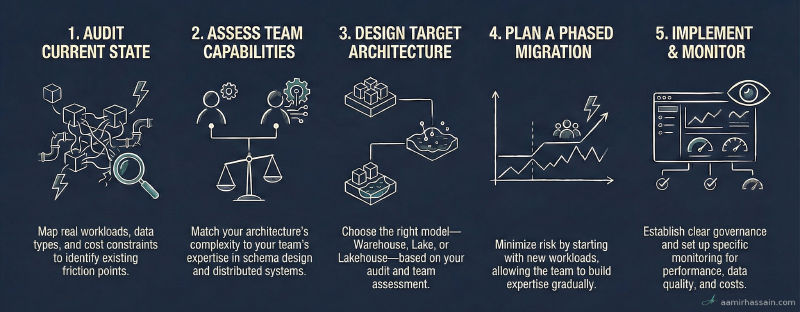
Evaluate your team’s operational maturity and expertise. Traditional warehouses require strong schema design skills but simpler operations. Data lakes demand expertise in distributed systems and data quality management. Lakehouses need both plus experience with metadata management and query optimization across multiple engines.
Design a migration strategy that minimizes risk while building toward your target architecture. Start with new workloads that align with your chosen direction rather than migrating existing systems immediately. This approach lets you build expertise and validate architectural decisions before committing fully.
Establish governance frameworks that work across your chosen architecture. Define data quality standards, access controls, and operational procedures that scale with your system complexity. Plan for metadata management, lineage tracking, and cost monitoring from the beginning.
Implement monitoring and alerting that covers the specific failure modes of your architecture. Warehouses need query performance and concurrency monitoring. Lakes require data quality and processing job health checks. Lakehouses need all of these plus metadata consistency and cross-engine compatibility validation.
Metrics: City Health and Infrastructure Costs#
Success metrics vary significantly across architectural approaches but center on the four north-star metrics: freshness, reliability, cost efficiency, and trust. Traditional warehouses typically achieve sub-hour freshness for structured data, maintain query success rates above ninety-nine percent, and provide predictable costs based on compute and storage usage. Data lakes optimize for cost per terabyte stored and processing flexibility, often accepting higher latency in exchange for economic efficiency.
Lakehouses aim to deliver warehouse-level performance metrics while maintaining lake-level cost efficiency. Key indicators include query performance across different engines, metadata consistency between storage and compute layers, and cost optimization through intelligent data placement and caching strategies.
Leading indicators of architectural stress include increasing query latency, rising storage costs without corresponding business value, growing operational overhead for routine tasks, and team velocity decreasing due to system complexity. These signals often appear months before systems reach breaking points, providing time for architectural adjustments.
The primary anti-fragility tactic is maintaining architectural optionality through open standards and portable data formats. Store data in formats like Parquet that work across multiple compute engines, implement metadata management that doesn’t lock you into specific vendors, and design data pipelines that can adapt to different storage and processing patterns. This approach enables evolutionary rather than revolutionary architectural changes when business requirements shift.
The Economics of Urban Development#
Cost structures differ dramatically across architectural approaches. Traditional warehouses typically charge for compute and storage together, making costs predictable but potentially expensive for infrequently accessed data. Data lakes separate storage and compute costs, enabling significant savings for large datasets but creating complexity in cost allocation and optimization.
The primary cost levers include data retention policies, compute resource sizing, and query optimization strategies. Warehouses benefit from aggressive data archiving and query tuning. Lakes require careful management of storage classes and compute cluster sizing. Lakehouses add complexity through metadata management costs and the need to optimize across multiple compute engines.
The biggest risk in architectural evolution is underestimating migration complexity and operational overhead. Teams often focus on the technical capabilities of new architectures while overlooking the organizational changes required for success. Data lakes require different skills and processes than warehouses. Lakehouses demand expertise in both plus additional complexity in metadata and query optimization.
Hidden costs include: Training and hiring for new skill sets, operational overhead during transition periods, data migration and validation efforts, and the opportunity cost of engineering time spent on infrastructure instead of business features. Many teams underestimate these costs by 2-3x, leading to budget overruns and delayed business value delivery.
Mitigation strategies include starting with pilot projects that validate both technical and operational assumptions, investing in team training before committing to new architectures, and maintaining fallback options during migration periods. The most successful architectural transitions happen gradually, allowing organizations to build expertise and refine processes before fully committing to new approaches.
Advanced Planning: Zoning for Success#
When evaluating lakehouse platforms, focus on metadata management capabilities and query engine compatibility rather than just performance benchmarks. The ability to maintain consistent metadata across different compute engines determines long-term flexibility more than raw query speed. Look for platforms that support open table formats like Iceberg or Delta Lake that provide vendor portability.
If you’re migrating from warehouses to lakes or lakehouses, maintain parallel systems during transition periods rather than attempting big-bang migrations. This approach reduces risk and provides fallback options when unexpected issues arise. Plan for 6-12 months of parallel operations to validate performance and operational procedures.
When designing data storage layouts, optimize for your most common access patterns while maintaining flexibility for exploratory workloads. Senior engineers use partitioning and clustering strategies that serve known use cases efficiently while avoiding over-optimization that constrains future requirements.
Common Infrastructure Failures#
Symptom: Query performance degrades significantly after migrating from warehouse to lake architecture. Root cause: Teams assume that schema-on-read means no optimization is needed, leading to inefficient file layouts and query patterns. Fix: Implement partitioning, clustering, and file size optimization strategies appropriate for your query patterns, and use columnar formats like Parquet for analytical workloads.
Symptom: Data governance becomes inconsistent across warehouse and lake systems in hybrid architectures. Root cause: Different systems use incompatible metadata management and access control mechanisms. Fix: Implement unified governance frameworks using tools like data catalogs and policy engines that work across multiple storage and compute platforms.
Symptom: Costs increase unexpectedly after adopting lakehouse architecture despite promises of better economics. Root cause: Teams don’t optimize for the specific cost model of their chosen platform, leading to inefficient resource usage and data placement. Fix: Understand your platform’s cost drivers, implement automated optimization for storage classes and compute resources, and monitor costs at the workload level rather than just system level.
Symptom: Team productivity decreases during architectural transitions as engineers struggle with new tools and patterns. Root cause: Organizations underestimate the learning curve and operational changes required for new architectures. Fix: Invest in comprehensive training programs, establish centers of excellence for new technologies, and maintain expertise in existing systems during transition periods.
Symptom: Data quality issues increase in lake-based systems compared to warehouse environments. Root cause: Schema-on-read architectures require different approaches to data validation and quality management. Fix: Implement data quality checks at ingestion time, use schema evolution management tools, and establish clear contracts between data producers and consumers.
Next Steps: Designing Your Metropolis#
The evolution from warehouses through lakes to lakehouses reflects the fundamental tension between performance optimization and operational flexibility in data systems. Like the smart city analogy, the most successful architectures combine the governance and efficiency of planned systems with the adaptability and economics of flexible approaches.
The decision you can make today is to evaluate your current architecture against your actual workload requirements rather than theoretical capabilities. Map your data types, query patterns, latency needs, and cost constraints to understand where your current approach creates friction or limits business value. This assessment provides the foundation for architectural decisions that enhance rather than constrain your team’s capabilities.
This architectural foundation enables the next level of data system sophistication: implementing open standards and formats that provide portability across different platforms and compute engines. Understanding how modern data formats like Parquet, Arrow, and table formats like Iceberg and Delta create the technical foundation that makes architectural evolution possible without vendor lock-in or data migration overhead will be crucial for your next architectural decisions.
What data architecture evolution challenges are you facing? Connect with me on LinkedIn to share your thoughts.