
The Lock-in Trap#
The data engineering team at a fast-growing e-commerce company discovers their carefully architected data platform has become a strategic liability overnight. Their cloud data warehouse vendor announces a significant price increase and deprecates key APIs their pipelines depend on. Migrating to an alternative would require rewriting thousands of transformation jobs, rebuilding data models, and retraining the entire analytics team. What seemed like a technical decision three years ago now threatens to consume months of engineering time and hundreds of thousands in migration costs.
This scenario repeats across organizations that built their data infrastructure around proprietary formats and vendor-specific features. The promise of managed services and optimized performance comes with hidden switching costs that only become apparent when business requirements change or vendor relationships sour. Teams that chose open standards from the beginning navigate these transitions smoothly, while those locked into proprietary ecosystems face expensive migrations or accept suboptimal vendor terms.
The difference between these outcomes lies in understanding which standards actually matter for long-term architectural flexibility and how to implement them without sacrificing performance or operational simplicity. Open standards are not just technical specifications—they are strategic insurance policies that preserve your team’s ability to adapt as requirements evolve.
From Walled Gardens to Global Trade#
Getting open standards right means your data architecture becomes vendor-agnostic by design rather than accident. Teams that build on open formats and protocols can evaluate new tools based on capabilities rather than migration costs. They can adopt best-of-breed solutions for different workloads without creating data silos or integration complexity.
The payoff extends beyond vendor flexibility. Organizations using open standards see measurable improvements in the north-star metrics that define data platform success: data freshness improves when pipelines can run on multiple compute engines, cost efficiency increases when you can optimize storage and compute independently, system reliability strengthens when you can switch providers during outages, and trust grows when data formats remain accessible regardless of vendor relationships.
The wrong standards choices, however, create technical debt that compounds over time, limiting your ability to adopt new technologies or negotiate favorable vendor terms. Teams end up maintaining multiple incompatible systems, struggling with data consistency across platforms, and burning engineering cycles on vendor-specific optimizations that don’t transfer to other tools. The business impact is measurable: slower time-to-market for data products, higher operational costs, and reduced negotiating power with vendors.
The 3 Pillars: Files, Tables, Compute#
Open standards in data engineering refer to publicly documented specifications for data formats, protocols, and APIs that enable interoperability across different tools and platforms. These standards are typically governed by neutral organizations, implemented by multiple vendors, and designed to prevent vendor lock-in while maintaining performance and functionality.
The key open standards that matter for modern data engineering fall into three categories: file formats like Parquet and Arrow that define how data is stored and processed in memory, table formats like Iceberg, Delta Lake, and Hudi that add transaction semantics and metadata management to file-based storage, and compute protocols that enable different engines to work with the same data efficiently.
File formats handle the physical representation of data. Parquet provides columnar storage optimized for analytical queries, while Arrow defines in-memory columnar layouts that enable zero-copy data sharing between processes. These formats work across dozens of tools and cloud providers, ensuring your data remains accessible regardless of your compute choices.
Table formats add warehouse-like capabilities to object storage through metadata layers that track schema evolution, provide ACID transactions, and enable time travel queries. Iceberg, Delta Lake, and Hudi each offer different approaches to these challenges while maintaining compatibility with multiple compute engines.
Not this: Open standards are not automatically better than proprietary alternatives in all situations, nor do they eliminate the need for vendor-specific optimizations and features. Many successful data platforms combine open standards for core data storage with proprietary tools for specialized workloads. Open standards also don’t guarantee perfect portability—implementations can vary, and migration between platforms still requires planning and testing even when using standard formats.
The Shipping Container Mental Model#
Think of open standards like standardized shipping containers in global logistics. Before containerization, moving cargo between ships, trucks, and trains required custom handling equipment and manual reloading at every transition point. Each transportation method had its own loading mechanisms, size constraints, and handling procedures. This created massive inefficiencies and limited the ability to optimize routes across different carriers.
Standardized containers enabled seamless transfers across different transportation modes, reduced costs, and accelerated global trade by making the cargo format independent of the transportation method. A container loaded in Shanghai can move efficiently through ships, trucks, and trains to reach its final destination without ever opening the container or handling individual items.
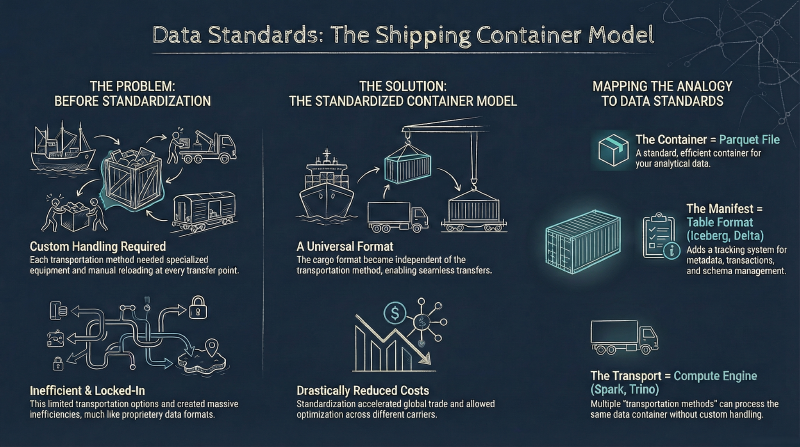
Open data standards serve the same function for data platforms. Parquet files are like standardized containers for analytical data—they work efficiently across Spark, Trino, BigQuery, Snowflake, and dozens of other compute engines. Table formats like Iceberg add the equivalent of shipping manifests and tracking systems, enabling ACID transactions and metadata management while preserving the underlying container compatibility.
This mental model helps evaluate standards decisions by asking: Does this format work like a standardized container that multiple tools can handle efficiently, or does it require custom handling that limits your transportation options? The answer guides whether you invest in open formats that preserve flexibility or accept proprietary optimizations that may constrain future choices.
Decision Framework: Choosing Your Standard#
Choose your data standards by evaluating three key dimensions: workload diversity, vendor relationship strategy, and long-term data value. This framework helps you match standards to reality rather than aspirations.
%%{init: {'theme':'base', 'themeVariables': {'fontSize': '18px', 'fontFamily': 'arial', 'primaryColor': '#e3f2fd', 'primaryTextColor': '#000', 'primaryBorderColor': '#1976d2', 'lineColor': '#1976d2'}, 'flowchart': {'nodeSpacing': 50, 'rankSpacing': 80}}}%%
flowchart TD
    A["Standards Decision
    Framework"] --> B{"Workload
    Diversity?"}

    B -->|"Single Tool/Platform
    Optimized Performance"| C["Consider Proprietary
    Formats"]
    B -->|"Multiple Tools
    Cross-Platform Needs"| D{"Vendor
    Strategy?"}
    B -->|"Highly Diverse
    Future Flexibility Critical"| E["Open Standards
    Required"]

    D -->|"Single Vendor
    Deep Partnership"| F["Hybrid: Open Storage
    Proprietary Optimization"]
    D -->|"Multi-Vendor
    Best-of-Breed"| G["Open Standards
    Recommended"]

    C --> H{"Long-term
    Data Value?"}
    F --> H
    G --> I["Implementation:
    Parquet + Table Format
    Cross-Engine Testing
    Migration Planning"]
    E --> I

    H -->|"Short-term
    Tactical Use"| J["Accept Proprietary
    Trade-offs"]
    H -->|"Long-term
    Strategic Asset"| K["Require Open
    Standards"]

    J --> L["Optimize for:
    Current Performance
    Vendor Integration
    Operational Simplicity"]

    K --> M["Optimize for:
    Future Portability
    Vendor Independence
    Long-term Accessibility"]

    I --> N["Optimize for:
    Multi-Engine Performance
    Governance Consistency
    Evolution Capability"]

    style A fill:#1976d2,stroke:#0d47a1,stroke-width:3px,color:#fff
    style B fill:#ff9800,stroke:#f57c00,stroke-width:2px,color:#fff
    style D fill:#ff9800,stroke:#f57c00,stroke-width:2px,color:#fff
    style H fill:#ff9800,stroke:#f57c00,stroke-width:2px,color:#fff

    style C fill:#f44336,stroke:#d32f2f,stroke-width:2px,color:#fff
    style E fill:#4caf50,stroke:#388e3c,stroke-width:2px,color:#fff
    style G fill:#4caf50,stroke:#388e3c,stroke-width:2px,color:#fff
    style F fill:#ff9800,stroke:#f57c00,stroke-width:2px,color:#fff
    style K fill:#4caf50,stroke:#388e3c,stroke-width:2px,color:#fff
Choose open file formats like Parquet when your data will be accessed by multiple tools or when long-term data preservation matters more than short-term performance optimizations. Parquet excels for analytical workloads where columnar compression and predicate pushdown provide significant benefits, and where you need compatibility across different compute engines and cloud providers.
Select table formats like Iceberg, Delta Lake, or Hudi when you need ACID transactions, schema evolution, and time travel capabilities on data lake storage while maintaining compatibility with multiple compute engines. These formats work best when you’re building lakehouse architectures, need to support both batch and streaming workloads, or want to avoid vendor lock-in while getting warehouse-like features.
Consider proprietary formats when performance requirements are extreme, when you’re deeply committed to a single vendor ecosystem, or when open standards don’t yet support critical features your workloads require. Some specialized use cases—like real-time analytics with microsecond latency requirements—may justify proprietary optimizations despite the flexibility costs.
The decision framework centers on three key factors: workload diversity, vendor relationship strategy, and long-term data value. High diversity with multi-vendor strategies favor open standards. Single-vendor commitments with extreme performance needs may justify proprietary formats. Data with long-term value that outlasts current vendor relationships should always use open standards to ensure future accessibility.
Case Study: Breaking Free from the Vendor#
Hypothetical example: A financial services company built their data lake using a cloud provider’s proprietary format that promised superior performance for their risk analytics workloads. The format delivered on performance promises, reducing query times by forty percent compared to open alternatives and providing seamless integration with the provider’s machine learning services. The team celebrated the optimization and built their entire analytical infrastructure around these performance gains.
However, when regulatory requirements demanded they implement a multi-cloud disaster recovery strategy, they discovered the proprietary format couldn’t be efficiently processed outside their primary cloud provider’s ecosystem. The specialized compression algorithms and metadata structures that enabled superior performance were tightly coupled to the provider’s compute engines. Migration to Parquet-based storage with Iceberg table format took six months and required rebuilding optimization strategies, but it enabled true multi-cloud portability and reduced their disaster recovery costs substantially.
More importantly, it allowed them to evaluate specialized analytics tools from different vendors without worrying about data format compatibility. They could now run the same datasets through Spark for large-scale processing, Trino for interactive queries, and specialized ML frameworks for model training. The initial performance penalty was recovered within three months through better tool selection and workload optimization across multiple engines.
This pattern illustrates the hidden costs of proprietary formats that only become apparent when business requirements change. Organizations that start with open standards may sacrifice some initial performance optimizations, but they preserve strategic flexibility that often proves more valuable than marginal performance gains. The key insight is that standards decisions have longer-term implications than most teams initially recognize, making future optionality often more valuable than current optimization.
Blueprint: Adopting the Standard#
Start by auditing your current data formats and identifying proprietary dependencies that could constrain future decisions. Document which systems use vendor-specific formats, what migration effort would be required to move to open standards, and where format choices limit your ability to adopt new tools or switch providers.
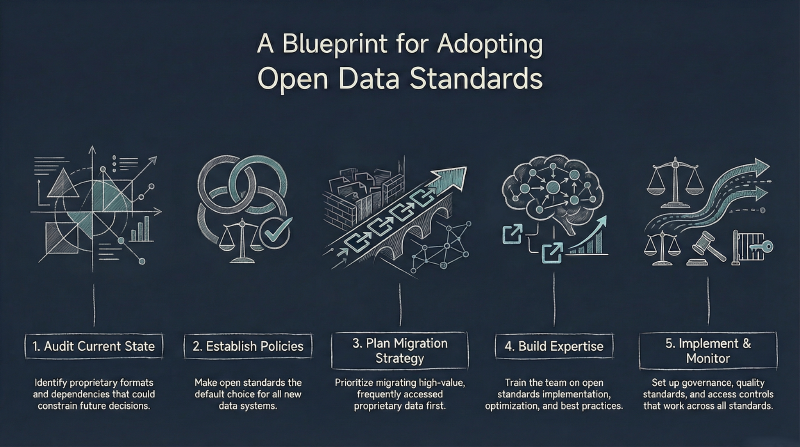
Establish open standards as the default choice for new data storage and processing systems. Use Parquet for analytical data storage, implement table formats like Iceberg or Delta for transactional capabilities, and choose compute engines that support multiple open formats rather than requiring proprietary alternatives. Create governance policies that require justification for proprietary format choices and regular review of vendor dependencies.
Design migration strategies for existing proprietary data that prioritize high-value datasets and frequently accessed information. Start with data that feeds multiple downstream systems or has long retention requirements, as these benefit most from format portability and future-proofing. Plan for parallel operations during migration periods to reduce risk and provide fallback options.
Build expertise in open standards implementation and optimization. Train your team on columnar format best practices, table format operations, and cross-engine compatibility considerations. Invest in tooling that helps optimize open formats rather than accepting performance penalties. Understanding how to tune Parquet file sizes, compression algorithms, and partitioning strategies is crucial for achieving performance parity with proprietary alternatives.
Implement monitoring and governance frameworks that work across your chosen standards. Define data quality standards, access controls, and operational procedures that scale with your system complexity. Plan for metadata management, lineage tracking, and cost monitoring from the beginning. Establish criteria for when proprietary optimizations are worth the flexibility costs, and create processes for monitoring when those trade-offs no longer make sense.
Metrics: Portability and Performance#
Success metrics for open standards adoption focus on portability, performance parity, and operational flexibility. Track the percentage of data stored in open formats, the number of different tools that can efficiently access your datasets, and the time required to onboard new compute engines or migrate between cloud providers. These metrics directly measure your architectural flexibility and vendor independence.
Performance metrics should demonstrate that open standards don’t significantly compromise analytical capabilities. Monitor query performance across different engines accessing the same Parquet datasets, measure compression ratios and storage efficiency compared to proprietary alternatives, and track the overhead of table format operations like compaction and metadata management. Establish baselines before migration and validate that open formats meet your performance requirements.
Leading indicators of standards-related issues include increasing vendor lock-in metrics, growing performance gaps between open and proprietary formats, and rising costs for maintaining compatibility across multiple tools. These signals often appear before standards choices become strategic constraints, providing time for architectural adjustments.
The primary anti-fragility tactic is maintaining multiple implementation options for critical data processing workflows. Ensure your most important datasets can be efficiently processed by at least two different compute engines, implement table format operations that work across multiple platforms, and design data pipelines that can adapt to different storage and processing patterns without major rewrites. This approach enables rapid response to vendor changes, performance requirements, or cost optimization opportunities.
The Economics of Open vs. Proprietary#
Open standards typically reduce long-term costs by enabling competition between vendors and preventing lock-in premiums, but they may increase short-term costs through performance optimization efforts and multi-tool compatibility testing. The primary cost drivers include storage efficiency differences between formats, compute optimization requirements, and operational overhead for managing multiple tool compatibility.
Key cost levers include file size optimization through proper compression and encoding choices, query performance tuning across different engines, and storage lifecycle management that takes advantage of open format portability. Parquet files benefit from column pruning and predicate pushdown optimization. Table formats require careful management of metadata overhead and compaction strategies to maintain performance while providing transactional capabilities.
The biggest risk in open standards adoption is assuming that “open” automatically means “optimized” or “compatible.” Different implementations of the same standard can have significant performance variations, and some tools may not support all features of open formats. Teams often underestimate the effort required to achieve performance parity with proprietary alternatives, leading to budget overruns and delayed migrations.
Hidden costs include: Training and hiring for open standards expertise, operational overhead during transition periods, performance optimization efforts across multiple engines, and the opportunity cost of engineering time spent on format compatibility instead of business features. Many teams underestimate these costs by 50-100%, particularly the ongoing optimization work required to maintain performance across different tools.
Mitigation strategies include thorough benchmarking of open format performance across your actual workloads, investing in optimization expertise for your chosen standards, and maintaining fallback options during transition periods. The most successful open standards implementations combine format portability with deep optimization knowledge, achieving both flexibility and performance through careful tuning rather than accepting suboptimal defaults.
Advanced Logistics: Optimization Secrets#
When implementing table formats, choose based on your ecosystem alignment and operational requirements rather than feature checklists. Iceberg works well in multi-engine environments and provides the strongest vendor neutrality. Delta Lake integrates tightly with Spark-centric workflows and offers excellent performance optimization. Hudi excels for streaming upsert patterns and change data capture scenarios.
If you’re migrating from proprietary formats, implement parallel processing during transition periods where both old and new formats are maintained until performance and reliability are validated. This approach reduces migration risk while providing fallback options when unexpected issues arise. Plan for 6-12 months of parallel operations to validate performance and operational procedures.
When optimizing open format performance, focus on file sizing, partitioning strategies, and column ordering that work well across multiple engines rather than over-optimizing for single tools. Use consistent compression algorithms that balance storage efficiency with query performance across your tool ecosystem.
Common Standardization Failures#
Symptom: Query performance degrades significantly after migrating to open formats like Parquet. Root cause: Teams use default settings without optimizing for their specific data characteristics and query patterns, leading to suboptimal file layouts and compression choices. Fix: Implement proper partitioning strategies, choose appropriate compression algorithms based on your data types, and optimize file sizes for your typical query patterns and cluster configurations. Parquet performance depends heavily on these optimizations.
Symptom: Table format operations like compaction and metadata management create operational overhead and performance bottlenecks. Root cause: Teams don’t establish proper maintenance schedules and optimization strategies for table format housekeeping, leading to metadata bloat and inefficient file layouts. Fix: Implement automated compaction policies based on file count and size thresholds, monitor metadata growth patterns, and establish clear operational procedures for table format maintenance tasks.
Symptom: Different tools produce inconsistent results when accessing the same open format datasets. Root cause: Schema evolution and data type handling differences between implementations of the same standard, particularly around timestamp handling and null value representation. Fix: Establish strict schema governance policies, test compatibility across all tools in your ecosystem before production deployment, and use schema registries to manage evolution consistently across all consumers.
Symptom: Storage costs increase unexpectedly after adopting open formats despite promises of better compression. Root cause: Suboptimal encoding choices and file layout strategies that don’t take advantage of columnar format benefits, often due to migrating row-based optimization patterns to columnar storage. Fix: Analyze your data characteristics to choose appropriate compression algorithms, implement proper column ordering based on query patterns, and optimize file sizes for your storage and compute patterns rather than using defaults.
Symptom: Migration to open standards takes much longer than expected due to performance and compatibility issues. Root cause: Teams underestimate the optimization effort required to achieve performance parity with proprietary systems and the complexity of validating compatibility across multiple tools. Fix: Plan for iterative optimization cycles, invest in format-specific expertise early in the migration process, and maintain parallel systems during transition periods to reduce migration pressure and provide fallback options.
Next Steps: Future-Proofing Your Architecture#
Open standards in data engineering function like the standardized shipping containers that revolutionized global logistics—they enable seamless movement between different platforms while preserving the data’s integrity and accessibility. The most successful data architectures combine the portability of open formats with the optimization expertise needed to achieve performance parity with proprietary alternatives.
The decision you can make today is to establish open standards as your default choice for new data systems while developing migration strategies for existing proprietary dependencies. Audit your current format choices, identify where vendor lock-in constrains your options, and prioritize open format adoption for data with long-term value or multi-tool access requirements. This assessment provides the foundation for architectural decisions that enhance rather than constrain your team’s capabilities.
This standards foundation enables the next level of data system sophistication: building architectures that leverage open formats effectively while maintaining the performance and governance characteristics your business requires. Understanding how to optimize open standards for your specific workloads, rather than accepting default configurations, determines whether your investment in vendor neutrality pays dividends in both flexibility and performance.
What open standards challenges are you facing? Connect with me on LinkedIn to share your thoughts.