
The Scaling Crisis#
The VP of Engineering stared at the quarterly planning board, counting twelve different teams requesting data engineering support. Marketing needed customer segmentation pipelines. Product wanted real-time feature flags. Finance required compliance reporting. Sales demanded lead scoring models. Meanwhile, the three-person data team was already working nights and weekends just to keep existing systems running.
This resource crunch forces a critical organizational decision that most companies face around their second year of serious data investment. Should they hire more centralized data engineers to serve all requests? Embed data engineers within each product team? Build a self-service platform that lets teams handle their own data needs? Or create some hybrid approach that balances autonomy with coordination?
The choice of team topology determines whether data becomes an organizational accelerator or bottleneck. Get it right, and teams move faster while maintaining data quality and governance. Get it wrong, and you create either chaos from lack of coordination or paralysis from too much centralization. The decision shapes everything from hiring plans to technology choices to stakeholder satisfaction.
Velocity vs. Chaos#
When team topology aligns with organizational maturity and business needs, data becomes a competitive advantage that compounds over time. Teams get the data support they need without waiting in long queues. Data quality remains high because clear ownership and accountability exist. Costs stay predictable because resource allocation matches actual demand patterns.
The business impact shows up in measurable ways: faster time-to-insight for business decisions, reduced operational overhead for data teams, improved data quality through clear ownership, and better cost efficiency through appropriate resource allocation. Organizations with well-designed data team topologies report significantly higher stakeholder satisfaction and faster delivery of data-driven features.
When topology mismatches organizational reality, the costs accumulate quickly. Centralized teams become bottlenecks that slow every business initiative. Embedded teams duplicate effort and create inconsistent data definitions. Platform teams build tools nobody uses. Federated approaches devolve into chaos without proper coordination mechanisms. The promise of data-driven decision-making becomes a source of organizational friction rather than business acceleration.
The Four Archetypes#
Team topology for data refers to how organizations structure data engineering capabilities across teams, reporting lines, and decision-making authority. It encompasses who owns data infrastructure, how data work gets prioritized, where data engineers report organizationally, and how coordination happens between teams with data needs.
The four primary topologies each optimize for different organizational characteristics. Centralized topology concentrates all data engineering in a single team that serves the entire organization. Embedded topology distributes data engineers within product or business teams. Platform topology creates a dedicated team that builds self-service tools for other teams. Federated topology combines central coordination with distributed execution across multiple teams.
Each topology implies different trade-offs in speed, consistency, cost, and governance. Centralized approaches maximize consistency but can create bottlenecks. Embedded approaches maximize speed but can sacrifice coordination. Platform approaches enable scale but require significant upfront investment. Federated approaches balance trade-offs but require sophisticated coordination mechanisms.
The Clinic vs. The Platform#
Think of data team topologies like different approaches to providing medical care in a large organization. A centralized model is like having one medical clinic that serves the entire company—everyone goes to the same place for care, ensuring consistent standards and specialized expertise, but potentially creating long wait times and less personalized service.
An embedded model is like having a nurse stationed in each department—immediate access to basic care and deep understanding of department-specific needs, but potentially inconsistent practices and limited specialized expertise. A platform model is like providing self-service health monitoring tools and telemedicine capabilities—enables departments to handle routine needs independently while maintaining access to specialists for complex cases.
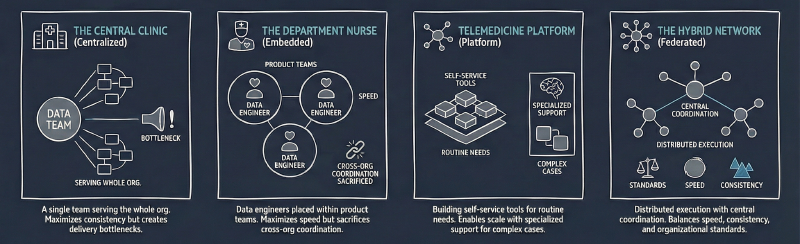
A federated model combines elements of all approaches—department nurses for immediate needs, shared specialists for complex cases, common tools and protocols for consistency, and central coordination for organization-wide health initiatives. The choice depends on organization size, complexity of needs, available resources, and tolerance for coordination overhead.
This medical analogy clarifies why topology choice matters so much. The wrong model creates either bottlenecks that slow everyone down or fragmentation that reduces quality and increases costs. The right model provides appropriate care at the right level while maintaining overall organizational health.
The Diagnostic Framework#
Choose centralized topology when your organization has fewer than five teams needing regular data support, when data requirements are relatively similar across teams, and when consistency and governance matter more than speed. Centralized works best for early-stage companies, highly regulated industries, and organizations where data engineering expertise is scarce.
Select embedded topology when product teams have distinct data needs that require deep domain knowledge, when speed of delivery matters more than consistency, and when you have enough data engineering talent to distribute across teams. Embedded topology excels in product-focused organizations, fast-moving startups, and companies where data requirements vary significantly between business units.
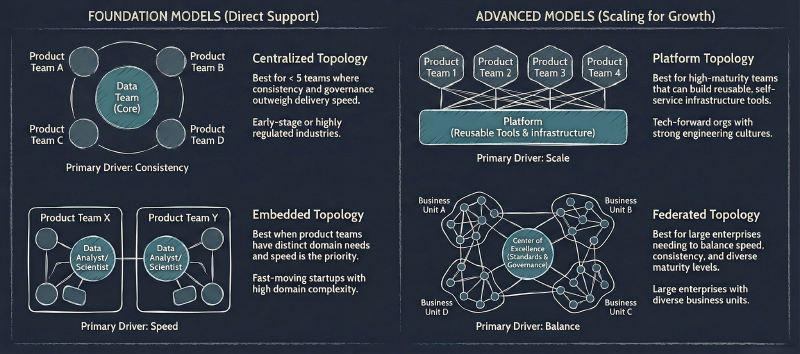
Implement platform topology when multiple teams need similar data capabilities, when you can invest in building reusable tools and infrastructure, and when self-service adoption is realistic given your organization’s technical maturity. Platform approaches work best for technology companies, organizations with strong engineering cultures, and companies that have already established basic data infrastructure.
Deploy federated topology when you need to balance speed and consistency, when different parts of the organization have varying data maturity levels, and when you have the coordination capabilities to manage distributed teams effectively. Federated models suit large enterprises, organizations with diverse business units, and companies transitioning between other topologies.
The decision framework evaluates three key dimensions: organizational scale and complexity, data engineering talent availability, and tolerance for coordination overhead versus delivery speed. Most organizations evolve through multiple topologies as they grow and mature.
Case Study: The Hybrid Evolution#
A growing e-commerce company started with a centralized data team of two engineers serving the entire organization. This worked well when they had three product teams and straightforward analytics needs. However, as they scaled to twelve product teams with diverse requirements—real-time personalization, fraud detection, inventory optimization—the central team became a bottleneck that slowed every product initiative.
The company experimented with embedding data engineers in each product team, which initially improved delivery speed but created new problems. Different teams built incompatible data pipelines, duplicated infrastructure costs, and struggled with complex requirements that exceeded individual team expertise. Data quality became inconsistent, and governance became nearly impossible.
Their eventual solution combined platform and federated approaches. They built a platform team that created self-service tools for common data operations while maintaining embedded data engineers in teams with the most complex requirements. Central coordination ensured consistency in data definitions and governance while preserving team autonomy for implementation details. This hybrid approach required eighteen months to implement but resulted in both faster delivery and better data quality.
This evolution pattern appears frequently in scaling organizations. Teams often start centralized, experiment with embedding, discover coordination challenges, and eventually settle on hybrid approaches that balance speed with consistency. The key insight is that topology choice must evolve with organizational maturity and complexity rather than remaining static.
The Evolution Roadmap#
Begin by assessing your current state across four dimensions: number of teams needing data support, diversity of data requirements, available data engineering talent, and organizational tolerance for coordination complexity. Document how data work currently gets prioritized and delivered to establish a baseline for improvement.
Next, identify the primary pain points in your current topology. Are teams waiting too long for data support? Are data engineers spread too thin across diverse requirements? Are teams building duplicate infrastructure? Are data quality and governance suffering from lack of coordination? These pain points guide topology selection.
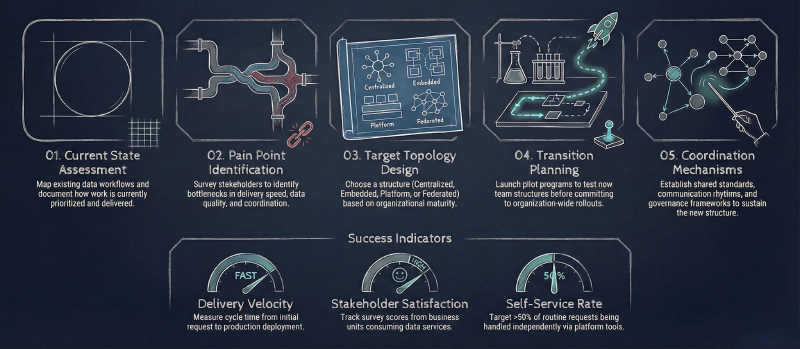
Design your target topology based on organizational constraints and strategic priorities. If speed matters most and you have sufficient talent, consider embedded approaches. If consistency and governance are critical, lean toward centralized or platform models. If you need to balance multiple priorities, explore federated options.
Plan the transition carefully, as topology changes affect team structures, reporting relationships, and technology choices. Start with pilot programs that test new approaches on limited scope before organization-wide rollouts. Establish clear success metrics and feedback mechanisms to guide the transition process.
Finally, build the coordination mechanisms that make your chosen topology work effectively. This includes communication rhythms, shared standards, escalation procedures, and governance frameworks. Invest in tooling and processes that reduce coordination overhead while maintaining necessary alignment.
Readiness checklist: Current state assessed, pain points identified, target topology designed, transition plan created, coordination mechanisms established.
Metrics That Matter#
Success metrics for team topology focus on delivery velocity, stakeholder satisfaction, and operational efficiency rather than traditional engineering metrics. Track time-to-delivery for data requests, stakeholder satisfaction with data support, and the ratio of new feature development to operational maintenance work.
Delivery velocity includes both speed and quality of data work completion. Measure cycle time from request to production deployment, frequency of rework due to quality issues, and percentage of requests that can be completed without cross-team coordination. These metrics reveal whether your topology enables or constrains organizational productivity.
Stakeholder satisfaction metrics include survey scores from teams that consume data services, escalation frequency for unresolved issues, and adoption rates for self-service capabilities where available. High satisfaction indicates that topology aligns with organizational needs and expectations.
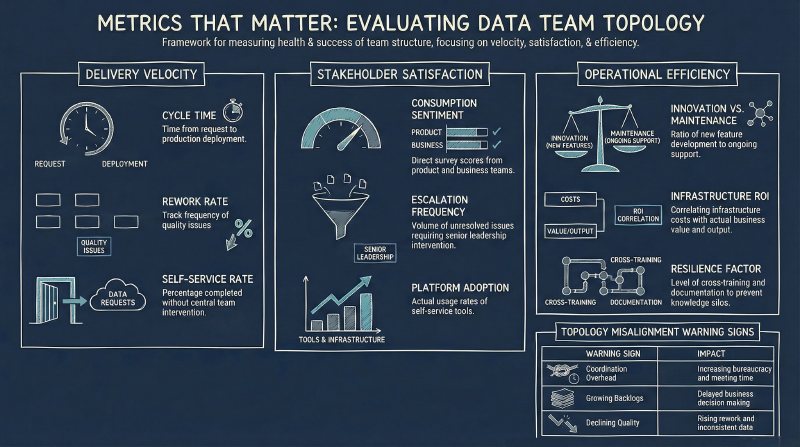
For resilience, maintain the ability to operate with reduced capacity in any part of your data organization. Cross-train team members on critical systems, document key processes and decisions, and establish clear escalation paths for issues that span team boundaries. Design systems with graceful degradation so problems in one area don’t cascade through the entire data organization.
Economics & Risks#
Team topology choices create different cost structures that extend beyond direct salary expenses. Centralized topologies minimize coordination costs but can create bottlenecks that slow business initiatives. Embedded topologies increase coordination costs but can accelerate product development. Platform topologies require significant upfront investment but can reduce long-term operational costs.
The most effective cost management approach is matching topology to organizational maturity and scale. Early-stage organizations typically can’t justify platform investments or federated coordination overhead. Large enterprises often can’t operate effectively with purely centralized approaches. The key is choosing topology that optimizes total cost of ownership rather than minimizing immediate expenses.
Two major risks threaten data team topology initiatives. Coordination overhead can grow faster than organizational benefits, creating bureaucracy that slows rather than accelerates data work. This happens when topology changes focus on organizational structure without investing in the tools and processes that make coordination efficient. Mitigate this risk by measuring coordination costs explicitly and optimizing processes continuously.
Skill gaps represent the second major risk. Different topologies require different organizational capabilities that may not exist initially. Platform topologies need product management and developer experience expertise. Federated topologies require sophisticated coordination and governance capabilities. Combat this by planning skill development alongside topology changes and hiring for organizational capabilities rather than just technical skills.
The most expensive mistake is changing topology without changing supporting systems and processes. Organizational structure alone doesn’t improve outcomes—it must be accompanied by appropriate tooling, communication rhythms, and governance frameworks.
Force Multipliers#
When designing topology changes, focus on information flow and decision-making authority rather than just reporting relationships. Teams need clear understanding of who makes what decisions and how information flows between groups. Organizational charts matter less than operational clarity.
If coordination overhead increases significantly after topology changes, examine whether you’ve created the right interfaces and shared standards. Most coordination problems stem from unclear boundaries and inconsistent practices rather than fundamental topology mismatches.
When stakeholders complain about data team responsiveness, investigate whether the problem is capacity, prioritization, or topology mismatch. Adding more people to the wrong topology often makes problems worse rather than better.
Diagnosing Dysfunction#
Symptom: Data requests take weeks or months to complete despite having sufficient engineering capacity. Root cause: Centralized topology with poor prioritization mechanisms and unclear service level expectations. Fix: Implement clear intake processes, service level agreements, and capacity planning that matches demand patterns. Consider embedded or platform approaches for routine requests.
Symptom: Different teams build incompatible data infrastructure and duplicate expensive resources. Root cause: Embedded topology without sufficient coordination mechanisms and shared standards. Fix: Establish architectural governance, shared tooling standards, and regular cross-team communication. Implement platform capabilities for common infrastructure needs.
Symptom: Self-service data tools have low adoption rates and teams continue requesting custom development. Root cause: Platform topology that doesn’t match organizational technical maturity or actual user needs. Fix: Invest in user research, improve tool usability, and provide training and support for adoption. Consider hybrid approaches that combine platform capabilities with human support.
Symptom: Data quality and governance deteriorate as organization scales, with inconsistent definitions and practices across teams. Root cause: Distributed topology without sufficient central coordination and governance frameworks. Fix: Implement federated governance with clear standards, regular audits, and escalation procedures. Establish data stewardship roles that span team boundaries.
Symptom: Topology changes create more problems than they solve, with decreased productivity and increased confusion. Root cause: Changing organizational structure without changing supporting processes, tools, and communication patterns. Fix: Plan topology changes as comprehensive organizational transformations that include process design, tool development, and change management. Measure success through business outcomes rather than organizational metrics.
Conclusion: The Adaptive Organization#
Team topology for data succeeds when it matches organizational maturity, business needs, and available capabilities while enabling clear accountability and efficient coordination. Like the medical care analogy, the best topology provides appropriate support at the right level while maintaining overall organizational health and consistency.
The key insight is that topology must evolve with organizational scale and complexity rather than remaining static. What works for a startup with five engineers won’t work for an enterprise with fifty teams. Successful organizations recognize when their current topology becomes a constraint and evolve proactively rather than reactively.
Today, you can start by mapping your current data team topology and identifying the primary pain points that affect delivery speed, stakeholder satisfaction, or operational efficiency. Document one critical data workflow and trace how it moves through your current organizational structure. This exercise will reveal whether your topology supports or hinders effective data work—and where to focus improvement efforts next.
Understanding team topology provides the organizational foundation for building scalable data capabilities. The next article in this series explores how to apply product thinking to data work, transforming data from a technical capability into a strategic business asset that drives measurable value.
Take action on team topology#
Ready to optimize your data team structure? Start with these concrete steps:
- Assess your current topology - Map how data work flows through your organization today
- Identify pain points - Survey stakeholders about delivery speed and satisfaction
- Design your target state - Choose the topology that matches your organizational maturity
- Plan the transition - Start with pilot programs before organization-wide changes
The choice of team topology determines whether data accelerates or constrains your business. Make it count.
What’s your experience with data team topologies? Connect with me on LinkedIn to share your thoughts.